
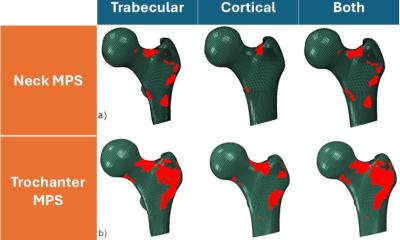
Image source: Morando N, Ruiz Wills C, Tassani S, Computers in Biology and Medicine 2025 (CC BY-NC-ND 4.0)
New Computational Model Enables Personalized Hip Fracture Risk Assessment
Thanks to the analysis model created by the UPF researchers, it will also be possible to better understand the specific causes of the process of bone tissue degeneration in each patient. “This will make it easier to design more personalized treatments that are tailored to their specific needs, for example, it will be possible to know which specific areas of the hip bone are most in need of calcium”, Simone Tassani (UPF) explains.
The new computational hip analysis model is based on previous methods created by UPF’s BCNMedTech Research Unit. These methods are based on a very common system used in engineering for calculating the impact that a movement or mechanical load has on the different parts of a structure (finite element model). Essentially, it consists of dividing the basic elements that make up a structure – based on its computerized three-dimensional representation – to calculate the impact of a virtual load or movement on each one.
Finite Element–Based Model Adapts Engineering Methods to Bone Analysis
Tassani clarifies that the application of this model on bones is especially complex: “In the case of bones, predicting the load caused by an impact or a movement is not as simple as with an object or a physical installation such as a bridge, because the materials of a bridge are uniform, but those of bones are not. In the case of a bridge, it is the point receiving the greatest load that will break, because everything is the same, but it not necessarily so in the case of bone tissue, whose mineral density, porosity, tissue orientation, etc. vary”. This study has enabled further adapting the previous model to the characteristics of hip bone tissue, complementing it with advanced statistical systems.
Bone Tissue Variability Key to Fracture Risk
The scientists have applied the new analysis model to the 90 women participating in the study. They examined the differences in the critical areas of the hip of patients with and without fracture, not point by point but by grouping the areas under comparison, thanks to a complex statistical method (statistical parametric map), which reduces the margin of error to a minimum. The comparison of the two groups has allowed concluding that the risk of fracture is higher when the bone tissue of the critical areas of the hip is more uniform. Conversely, it is lower if the bone tissue is more varied.
The design of the new analysis model, the identification of critical areas and the results of comparative studies on women with and without hip fracture provide highly relevant conclusions, paving the way for improving the diagnosis and treatment of hip fracture among women.
Source: Pompeu Fabra University Barcelona