
“See you tomorrow night,” Salvador Dalí wrote on the bottom of a sketch of a dress made to look like a skeleton before sending it over to his friend Elsa Schiaparelli. Framed on a wall at the Victoria & Albert Museum next to the famous skeleton dress itself, made in 1938, the offhand note offers striking insight into the fashion designer’s place at the center of a dynamic, radical web of artists and designers in Paris in the 1930s. “Schiaparelli: Fashion Becomes Art,” the first exhibition for the Italian icon in the UK, draws out the ways she influenced—and was influenced by—the tides of the avant-garde at Modernism’s height.
Her great rival for the crown of fashion queen of 1930s Paris, Coco Chanel, called Schiaparelli “that Italian artist who’s making clothes.” She makes a good point, despite the obvious venom of the remark. Schiaparelli was a woman of two worlds— fine art and fashion design—or, perhaps, a woman who revealed the blurriness between them. Her work, which was often viewed as derivative of Surrealism, was anything but, as this exhibition makes clear: Her ideas made their way into Surrealist paintings and designs as much as they moved the other direction. The exhibition’s curators argue that she was a catalyst for Surrealist innovation as much as a beneficiary of it. Dalí’s famous lobster telephone, for example, was made after he’d created a lobster dress for Schiaparelli in 1936, during a period when he was fascinated by lobsters. Meret Oppenheim made her fur-covered teacup, Object, after joking with Picasso about a fur bangle she’d designed for Schiaparelli. Man Ray painted a harlequin with a candlelit lantern for a head in 1939, taking direct inspiration from Schiaparelli’s Harlequin coat from her Modern Comedy collection, launched in October 1938. Picasso was so taken with a series of hats she’d made with horseshoes on them that he painted a portrait of Nusch Éluard wearing one.
View of “Schiaparelli: Fashion Becomes Art,” 2026, at the V&A, London.
©Victoria & Albert Museum, London
Fashion fit easily under the umbrella of Surrealist thought, even though it was still regarded as less than “fine art.” The Surrealist attitude of treating everyday objects as subjects or tools for art meant that clothing was ripe for novel creative innovation. The uncanniness of twisting the paraphernalia of daily life into something unfamiliar or strange satisfied the Surrealist desire to subvert convention and tap into the unconscious.
The other side of Schiaparelli’s legacy was her total embrace of the realities of the modern woman. While some of her clothes were outlandish and impractical, most were insistently in line with the needs of an urban, often professional, woman. She designed excellent trouser suits, iconic trompe l’oeil sweaters made to look like blouses, and jackets with expanded pockets to preclude the need for a purse. Her use of excitingly new materials, mostly in the general family of plastic, set her apart. She incorporated visible zippers—a new technology—into her designs, and gave thought to her garments’ packability for the traveling woman. There was a real girl’s-girl energy about her commitment to balancing fun with utility.

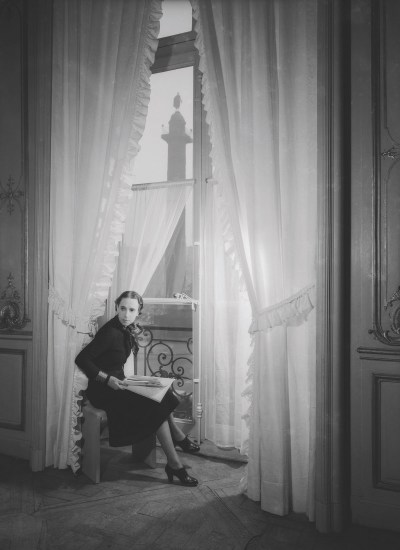
Elsa Schiaparelli in her boutique in Paris in 1935.
©Photo Fran ois Kollar/ GrandPalaisRmn-Gestion droit d’auteur François Kollar
Her work was constantly navigating whimsy and politics: During the World War II, she made a jacket covered in vegetables, down to tasseled carrot buttons. It’s adorably sweet, but it was also calculated to reflect national values around home-grown food and self-sufficiency in wartime. Indeed, her buttons often distilled big themes. In her remarkable Circus Collection from 1938, she made a fun, relatively mainstream pink jacket, but gave it porcelain buttons in the shape of acrobats. Some of her buttons were commissioned from other artists, including Alberto Giacometti. In one of the final rooms of the exhibition, there is a whole case of buttons, all of which are incredible.
Schiaparelli isn’t a household name like Chanel and Christian Dior, both subjects of similar large-scale fashion exhibitions at the V&A. She operated her fashion house from 1927 till it closed in 1954. The brand stayed defunct until it was purchased by Diego Della Valle and brought back to market in the 2010s. Maison Schiaparelli has had a renaissance under current creative director Daniel Roseberry, whose designs are also included in the V&A’s exhibition. It’s an unusual narrative for a fashion house anyway, but Roseberry’s work—for all its homages to Schiaparelli’s designs—feels superfluous to the real meat of the show.

View of “Schiaparelli: Fashion Becomes Art,” 2026, at the V&A, London.
©Victoria & Albert Museum, London
“Fashion Becomes Art” continues the truly incredible production values of the V&A’s other fashion exhibitions, including shows on Chanel and Dior, as well as the jewelry house Cartier, which feel like theme park experiences. These shows, presented in partnership with brands still doing business, are delectable, sparkling journeys through gorgeously produced cases of knockout fashion wares; but the feeling one is generally left with is the desire to own the items behind the glass rather than a deep critical engagement with design history or production. Perhaps this dynamic points to the realities of the economy of fashion, which is more visibly inextricable from capitalism than fine art—a topic we are more comfortable couching in a vague intellectualism that stands apart from money.
Aside from a longing to wear her trompe l’oeil sweaters, my main sense as I left the Schiaparelli show was a deep admiration for the depth of her network. The women she dressed included Hollywood stars Katharine Hepburn and Marlene Dietrich as well as the aviator Amy Johnson and divorcée-duchess Wallis Simpson. The vibrant dynamism of her creative exchanges with her friends and customers produced amazing clothes. Her novel attitude toward the creative potential of everyday objects was fueled by a collaborative energy and an embrace of the tension between art and design—a tension that remains both unresolved and galvanizing today.