
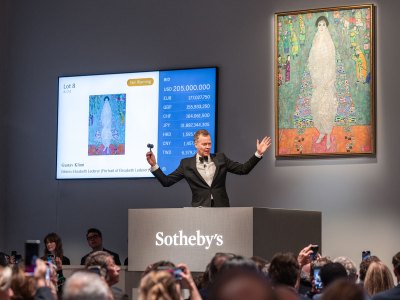
The global art market clawed its way back to modest growth in 2025, reaching an estimated$59.6 billion in sales, according to the latestArt Basel and UBS Art Market Report, by economist Clare McAndrew of Arts Economics. The total represents a4 percent increase from the previous year, breaking a two-year slide in sales—though the market still sits below its 2022 peak.
The recovery, however, came with an asterisk. While auctions bounced back strongly, galleries barely budged, and much of the market’s growth came from a small number of very expensive works.
Public auction sales rose9 percent, helping lift the overall market. Dealer sales grew just2 percent, reaching$34.8 billionglobally. Private sales at auction houses, meanwhile, fell5 percent, reversing the previous year’s trend, when collectors had increasingly opted for discreet deals behind closed doors.
The number of transactions barely changed. Sales rose only2 percent, to roughly41.5 million, suggesting that the market’s growth had less to do with a surge in activity than with higher prices for a relatively small number of big-ticket works.
As in previous years, the art trade remained concentrated in a handful of markets. TheUnited States, the United Kingdom, and China together accounted for 76 percent of global sales by value. The U.S. retained its position as the world’s largest art market, with$26 billion in sales, or44 percent of the global total. The UK followed with18 percent, while China accounted for14 percent.
Much of the market’s growth was driven by a revival of high-value transactions, particularly in New York. The combined value of works sold at auction in the United States for more than$10 million jumped nearly 40 percent, a reminder that trophy works still play an outsized role in shaping the market’s fortunes.

The same pattern was visible along the breadth of the auction sector. The value of works selling for more than$1 million rose 21 percent, while sales above$10 million climbed 30 percent. At the other end of the spectrum, sales of works priced below$50,000 slipped slightly, widening the gap between the top of the market and everything beneath it.
The year’s strongest auction sectors were those anchored by historically established artists.Impressionist and Post-Impressionist art surged 47 percent, while theOld Masters market rose 30 percentafter two years of decline. By contrast, the once red-hotPostwar and Contemporary category slipped 2 percent to $4.5 billion, an extension of the cooling that followed the pandemic-era boom.
The shift hints at a market growing more cautious. In uncertain economic times, collectors tend to gravitate toward artists with long track records rather than newer names still riding waves of speculation.
That caution showed up among galleries as well. Dealer sales returned to growth overall, but results varied sharply depending on size. Smaller galleries with annual sales under$500,000reported some of the strongest percentage increases in sales. The middle of the market, however, remained largely stagnant. Dealers with turnover above$10 millionmanaged a modest3 percent increaseafter two years of decline.
Meanwhile costs kept climbing. Dealers are selling more but reported higher expenses for shipping, logistics, and art fairs, pushing average operating costs uparound 5 percent in 2025, faster than sales growth can keep up.
“In past reports, much of the conversation focused on sales and revenue,” said Art Basel CEONoah Horowitz. “This year’s data shows sales recovering and confidence returning. Yes, the performance is mixed. Some parts of the market are stronger than others, and cost pressures remain a real challenge. But the trend is up.”
Horowitz said those rising operation costs are shaping how galleries approach the market. Even as sales begin to recover, higher expenses for shipping, logistics, staffing, and art fairs are forcing many dealers to operate more strategically and manage costs more carefully.
Despiteseveralwidely publicizedgalleryclosures, the report suggests the overall ecosystem remains relatively stable. New gallery openings still outpaced closures, indicating a market that is reshaping itself rather than shrinking. “I’m not going to underestimate the impact of Tim Blum, Venus over Manhattan, or Clearing closing their doors,” Horowitz said, “But when you start seeing new galleries opening at a faster pace, younger galleries come into the scene,and innovative ventures being formed, that suggests the market is renewing itself. It’s a good sign.”

Art fairs, meanwhile,remain centralto the business. Fairs accounted for35 percent of dealer sales in 2025, up from31 percent the year before, reinforcing their role as the industry’s main marketplace for connecting galleries with international collectors.
The pandemic-era rush toward digital sales also continued to fade.Online-only transactions fell to $9.2 billion, their lowest level since 2019, accounting for15 percent of the market, well below the25 percent peak reached in 2020.
Much of that decline reflects the return of high-value transactions to physical spaces in auction rooms, galleries, and art fairs, the places where collectors still prefer to see major works in person before committing millions.
Politics and economics also hovered over the market in 2025. Dealers and auction houses cited uncertainty aroundtariffsandtrade policy, particularly in the United States, as a growing concern.
Imports of art and antiques into the U.S. rose13 percent to $9.9 billion, in part as collectors and dealers moved works ahead of potential trade disruptions.
For now, the art market is growing again, just unevenly. A handful of blockbuster sales helped push the numbers upward in 2025, meanwhile much of the market has continued to successfully tread water to safety.