
nnnnnnn
ntBy 1930 Calder sought to distance himself from what had brought him early recognition. His discovery of Piet Mondrianu2019s studio at 16 Rue du Du00e9part in Paris that October acted as a catalyst for his turn toward nonfigurative art. Calder later recalled that the visit gave him u201cthe shock that convertedu201d him. This shift soon materialized in a series of nonobjective compositions, some of which were shown at the Galerie Percier in 1931.</p>nnnn
ntIn the fall of 1931, Calder produced his first kinetic sculptures. It was Marcel Duchamp who proposed the term u201cmobilesu201d to describe them. Some of these early works incorporated motors used to create controlled movements and introduce an element of calculated unpredictability. Gradually, however, Calder moved toward works activated by natural forces such as air currents, opening the system to chance and variability. In this context, forms could unfold through a potentially infinite number of configurations, shifting away from any fixed composition. Some critics have read his pursuit of expanded spatial perception and movement through space as an exploration of the u201cfourth dimension.u201d</p>nnnn
ntInSmall Sphere and Heavy Sphere</em>(1932u201333), Calder conceived his first suspended mobile, activated by spectators and thus completed by them. They had to first arrange a series of objects around itu2014bottles, a tin can, a wooden box, a gongu2014and then quickly set a red iron ball in motion to trigger a sequence of free movements. Like a pendulum, the energy of the heavy metal sphere acts on a small wooden sphere, causing it to swing among the objects. Some critics have described the essential dynamic between spectators and the artwork in terms of a u201cfifth dimension.u201d</p>n</div>”,”alt”:”Alexander Calder, Object with Red Discs</em>, 1931″,”image_credit”:”Collection of the Whitney Museum of American Art. Artwork copyright u00a9 2026 Calder Foundation, New York/ADAGP, Paris. Digital image u00a9 Whitney Museum of American Art/Licensed by Scala/Art Resource, New York, courtesy of Calder Foundation, New York.”,”url”:”https://www.artnews.com/list/art-news/artists/alexander-calder-who-was-why-important-vuitton-retrospective-1234782129/”,”image_id”:1234782213,”image”:”https://www.artnews.com/wp-content/uploads/2026/04/31_Alexander-Calder-Object-with-Red-Discs-1931-copy.jpg?w=1024″,”sizes”:{“pmc-gallery-s”:{“src”:”https://www.artnews.com/wp-content/uploads/2026/04/31_Alexander-Calder-Object-with-Red-Discs-1931-copy.jpg?w=180″,”width”:180,”height”:240},”pmc-gallery-m”:{“src”:”https://www.artnews.com/wp-content/uploads/2026/04/31_Alexander-Calder-Object-with-Red-Discs-1931-copy.jpg?w=360″,”width”:360,”height”:480},”pmc-gallery-l”:{“src”:”https://www.artnews.com/wp-content/uploads/2026/04/31_Alexander-Calder-Object-with-Red-Discs-1931-copy.jpg?w=450″,”width”:450,”height”:600},”pmc-gallery-xl”:{“src”:”https://www.artnews.com/wp-content/uploads/2026/04/31_Alexander-Calder-Object-with-Red-Discs-1931-copy.jpg?w=576″,”width”:576,”height”:768},”pmc-gallery-xxl”:{“src”:”https://www.artnews.com/wp-content/uploads/2026/04/31_Alexander-Calder-Object-with-Red-Discs-1931-copy.jpg?w=767″,”width”:767,”height”:1024}},”fullWidth”:431,”fullHeight”:575,”mime_type”:”image”,”ad”:””,”appleSongID”:null,”enableAppleGA”:false,”additionalDescription”:null,”subtitleColor”:null,”additionalSubtitle”:null,”additionalSubtitleColor”:null,”ads”:{“html”:”t
nttttt
nttttn
nt
nttnt</div>n</div>nttt</div>ntttt</div>n”,”data”:[{“divId”:”gpt-dsk-tab-list-inlistx-uid1″,”displayType”:”medrec”,”targeting”:[{“key”:”pos”,”value”:”btf”},{“key”:”pos”,”value”:”mid”},{“key”:”pos”,”value”:”in-listX”}],”lazyLoad”:”no”,”lazyLoadMultiplier”:2,”zone”:”list/in-listX”,”sizes”:[[300,250],[300,251]]}]}},{“ID”:1234782191,”position”:2,”positionDisplay”:3,”date”:”2026-04-21 15:11:19″,”modified”:”2026-04-21 17:02:00″,”title”:”Return to New York”,”subtitle”:null,”slug”:”return-to-new-york”,”caption”:”Alexander Calder, Eucalyptus</em>, 1940″,”description”:”ntttt
nnnnnnn
ntIn July 1933, Calder returned to New York with his wife, Louisa, aboard the SS Manhattan</em>, in the company of Hu00e9lion. He would later establish a studio in Roxbury, Connecticut, which allowed him to collaborate with American patrons and institutions that supported the production and exhibition of his increasingly ambitious pieces. This period marked a shift toward a more organic style, in parallel with the biomorphic works of contemporaries Jean Arp and Joan Miru00f3.</p>nnnn
ntIn the 1930s, Calderu2019s abstract pieces took on forms and movements reminiscent of plants and animals, a theme he would pursue over the next two decades in works including Steel Fish</em> (1934), one of his first outdoor sculptures; Four Leaves and Three Petals </em>(1939); Eucalyptus</em> (1940); and Bougainvillier</em> (1947). About Peacock</em> (1941), philosopher Jean-Paul Sartre, its recipient, once said: u201cHe gave me an iron-winged bird of paradise. It takes only a little warm air to brush again it as it escapes from the window and, with a little click, the bird smooths its feathers, rises up, spreads its tail, nods its crested head, rolls around, its wings outspread.u201d</p>n</div>”,”alt”:”Alexander Calder, Eucalyptus</em>, 1940″,”image_credit”:”Collection of the Calder Foundation, New York. Artwork copyright u00a9 2026 Calder Foundation, New York/ADAGP, Paris. Digital image: Tom Powel Imaging /Art Resource, New York, courtesy of Calder Foundation, New York.n”,”url”:”https://www.artnews.com/list/art-news/artists/alexander-calder-who-was-why-important-vuitton-retrospective-1234782129/”,”image_id”:1234782221,”image”:”https://www.artnews.com/wp-content/uploads/2026/04/40_Alexander-Calder-Eucalyptus-1940-copy-1.jpg?w=1024″,”sizes”:{“pmc-gallery-s”:{“src”:”https://www.artnews.com/wp-content/uploads/2026/04/40_Alexander-Calder-Eucalyptus-1940-copy-1.jpg?w=180″,”width”:180,”height”:240},”pmc-gallery-m”:{“src”:”https://www.artnews.com/wp-content/uploads/2026/04/40_Alexander-Calder-Eucalyptus-1940-copy-1.jpg?w=359″,”width”:359,”height”:480},”pmc-gallery-l”:{“src”:”https://www.artnews.com/wp-content/uploads/2026/04/40_Alexander-Calder-Eucalyptus-1940-copy-1.jpg?w=449″,”width”:449,”height”:600},”pmc-gallery-xl”:{“src”:”https://www.artnews.com/wp-content/uploads/2026/04/40_Alexander-Calder-Eucalyptus-1940-copy-1.jpg?w=575″,”width”:575,”height”:768},”pmc-gallery-xxl”:{“src”:”https://www.artnews.com/wp-content/uploads/2026/04/40_Alexander-Calder-Eucalyptus-1940-copy-1.jpg?w=766″,”width”:766,”height”:1024}},”fullWidth”:430,”fullHeight”:575,”mime_type”:”image”,”ad”:””,”appleSongID”:null,”enableAppleGA”:false,”additionalDescription”:null,”subtitleColor”:null,”additionalSubtitle”:null,”additionalSubtitleColor”:null,”ads”:{“html”:”t
nttttt
nttttn
nt
nttnt</div>n</div>nttt</div>ntttt</div>n”,”data”:[{“divId”:”gpt-dsk-tab-list-inlistx-uid2″,”displayType”:”medrec”,”targeting”:[{“key”:”pos”,”value”:”btf”},{“key”:”pos”,”value”:”mid”},{“key”:”pos”,”value”:”in-listX”}],”lazyLoad”:”no”,”lazyLoadMultiplier”:2,”zone”:”list/in-listX”,”sizes”:[[300,250],[300,251]]}]}},{“ID”:1234782195,”position”:3,”positionDisplay”:4,”date”:”2026-04-21 15:15:38″,”modified”:”2026-04-21 17:01:12″,”title”:”New York and Paris”,”subtitle”:null,”slug”:”new-york-and-paris”,”caption”:”Alexander Calder, Constellation</em>, 1943″,”description”:”ntttt
nnnnnnn
ntIn 1937 Calder returned to Paris, where he set up a studio in a garage outfitted with an automotive turntable, likely to facilitate the viewing and adjusting of his sculptures. That same year, he was commissioned to createu00a0Mercury Fountain</em>u00a0for the Spanish Pavilion at the International Exposition in Paris. The work included mercury mined in Almadu00e9n, Spain, a material that symbolized Republican resistance during the Spanish Civil War.u00a0It </em>was shown alongside Picassou2019su00a0Guernica </em>and Miru00f3u2019su00a0The Reaper</em>, reflecting the political engagement of these artists.</p>nnnn
ntBack in New York in 1938, Calder began construction of a large studio on the foundations of an old dairy barn in Roxbury and shortly afterward converted the adjoining icehouse studio into a living space known as the u201cBig Room.u201d That same year, his first retrospective,u201cCalder Mobiles</em>,u201d was presented at the George Walter Vincent Smith Art Gallery in Springfield, Massachusetts. The show included 61 pieces of jewelry, and among the guests at the opening were designer Alvar Aalto and painter Fernand Lu00e9ger. A year later, Calder was commissioned by the Museum of Modern Art in New York to createLobster Trap and Fish Tail</em>, a mobile installed in the principal stairwell of the museumu2019s new building on West 53rd Street.</p>nnnn
ntBetween the late 1930s and the early 1940s, Calderu2019s works were showcased at the Pierre Matisse Gallery in New York. The exhibitions included large-scale bolted stabiles, kinetic sculptures, and delicate pieces of jewelryu2014highlighting the breadth of his investigation of movement, balance, and material. In 1943, the gallery presented his first u201cConstellations,u201d a series of painted wood assemblages that marked yet another turning point in his career. Developed during the constraints of the Second World War, when access to metal was limited, the u201cConstellationsu201d consisted of geometric and organic elements arranged in intricate networks, suspended, mounted, or placed on surfaces to create miniature universes. Each componentu2019s position was essential to the pieceu2019s rhythm and dynamic effect; improper placement diminished its visual impact. With these works Calder articulated a personal, almost cosmic vision, transforming his sculptural elements into an experience that engaged viewers both emotionally and spatially, bridging the tangible and the conceptual.</p>n</div>”,”alt”:”Alexander Calder, Constellation</em>, 1943″,”image_credit”:”Private collection. Artwork copyright u00a9 2026 Calder Foundation, New York/ADAGP, Paris. Digital image: Courtesy of Calder Foundation, New York.”,”url”:”https://www.artnews.com/list/art-news/artists/alexander-calder-who-was-why-important-vuitton-retrospective-1234782129/”,”image_id”:1234782241,”image”:”https://www.artnews.com/wp-content/uploads/2026/04/43_Alexander-Calder-Constellation-1943-copy-1.jpg?w=1024″,”sizes”:{“pmc-gallery-s”:{“src”:”https://www.artnews.com/wp-content/uploads/2026/04/43_Alexander-Calder-Constellation-1943-copy-1.jpg?w=192″,”width”:192,”height”:240},”pmc-gallery-m”:{“src”:”https://www.artnews.com/wp-content/uploads/2026/04/43_Alexander-Calder-Constellation-1943-copy-1.jpg?w=384″,”width”:384,”height”:480},”pmc-gallery-l”:{“src”:”https://www.artnews.com/wp-content/uploads/2026/04/43_Alexander-Calder-Constellation-1943-copy-1.jpg?w=480″,”width”:480,”height”:600},”pmc-gallery-xl”:{“src”:”https://www.artnews.com/wp-content/uploads/2026/04/43_Alexander-Calder-Constellation-1943-copy-1.jpg?w=614″,”width”:614,”height”:768},”pmc-gallery-xxl”:{“src”:”https://www.artnews.com/wp-content/uploads/2026/04/43_Alexander-Calder-Constellation-1943-copy-1.jpg?w=819″,”width”:819,”height”:1024}},”fullWidth”:460,”fullHeight”:575,”mime_type”:”image”,”ad”:””,”appleSongID”:null,”enableAppleGA”:false,”additionalDescription”:null,”subtitleColor”:null,”additionalSubtitle”:null,”additionalSubtitleColor”:null,”ads”:{“html”:”t
nttttt
nttttn
nt
nttnt</div>n</div>nttt</div>ntttt</div>n”,”data”:[{“divId”:”gpt-dsk-tab-list-inlistx-uid3″,”displayType”:”medrec”,”targeting”:[{“key”:”pos”,”value”:”btf”},{“key”:”pos”,”value”:”mid”},{“key”:”pos”,”value”:”in-listX”}],”lazyLoad”:”no”,”lazyLoadMultiplier”:2,”zone”:”list/in-listX”,”sizes”:[[300,250],[300,251]]}]}},{“ID”:1234782198,”position”:4,”positionDisplay”:5,”date”:”2026-04-21 15:18:26″,”modified”:”2026-04-21 17:00:03″,”title”:”A MoMA Retrospective and Public Commissions”,”subtitle”:null,”slug”:”a-moma-retrospective-and-public-commissions”,”caption”:”Alexander Calder, Red Maze III</em>, 1954″,”description”:”ntttt
nnnnnnn
ntThat same year marked a decisive moment in Calderu2019s institutional recognition when theu00a0Museum of Modern Artu00a0in New York mounted a major retrospective, organized byu00a0James Johnson Sweeney. Bringing together works that ranged from early wire sculptures to recent abstract compositions, the exhibition established Calder as a central figure in modern art, framing his exploration of movement not as a marginal experiment but as a fundamental redefinition of sculptural practice.</p>nnnn
ntAfter resuming his pendular life between Paris and New York and traveling from India to Venezuela, Brussels, Italy, and Spain, Calder became increasingly absorbed by major public commissions. His international stature was definitively affirmed in 1952, when he was awarded the International Prize for Sculpture at theVenice Biennale. By the late 1950s he was simultaneously engaged in three large-scale projects spanning two continents and relying on three foundries; the industrial and logistical complexity led him to joke that he felt like an important businessman. These works includedSpirale (1958)</em>, a monumental mobile destined for the UNESCO headquarters in Paris; .125 </em>(1957), a 45-foot mobile for Idlewild Airport in New York (now JFK); andThe Whirling Ear</em>(1958) for the Brussels Worldu2019s Fair, projects that together marked his definitive entry into architectural and infrastructural space.</p>n</div>”,”alt”:”Alexander Calder, Red Maze III</em>, 1954″,”image_credit”:”Private collection. Artwork u00a9 2026 Calder Foundation, New York / ADAGP, Paris. Digital image: Art Resource, New York, courtesy of Calder Foundation, New York.”,”url”:”https://www.artnews.com/list/art-news/artists/alexander-calder-who-was-why-important-vuitton-retrospective-1234782129/”,”image_id”:1234782240,”image”:”https://www.artnews.com/wp-content/uploads/2026/04/54_Alexander-Calder-Red-Maze-III-1954-copy.jpg?w=1024″,”sizes”:{“pmc-gallery-s”:{“src”:”https://www.artnews.com/wp-content/uploads/2026/04/54_Alexander-Calder-Red-Maze-III-1954-copy.jpg?w=266″,”width”:266,”height”:240},”pmc-gallery-m”:{“src”:”https://www.artnews.com/wp-content/uploads/2026/04/54_Alexander-Calder-Red-Maze-III-1954-copy.jpg?w=532″,”width”:532,”height”:480},”pmc-gallery-l”:{“src”:”https://www.artnews.com/wp-content/uploads/2026/04/54_Alexander-Calder-Red-Maze-III-1954-copy.jpg?w=666″,”width”:666,”height”:600},”pmc-gallery-xl”:{“src”:”https://www.artnews.com/wp-content/uploads/2026/04/54_Alexander-Calder-Red-Maze-III-1954-copy.jpg?w=852″,”width”:852,”height”:768},”pmc-gallery-xxl”:{“src”:”https://www.artnews.com/wp-content/uploads/2026/04/54_Alexander-Calder-Red-Maze-III-1954-copy.jpg?w=1136″,”width”:1136,”height”:1024}},”fullWidth”:638,”fullHeight”:575,”mime_type”:”image”,”ad”:””,”appleSongID”:null,”enableAppleGA”:false,”additionalDescription”:null,”subtitleColor”:null,”additionalSubtitle”:null,”additionalSubtitleColor”:null,”ads”:{“html”:”t
nttttt
nttttn
nt
nttnt</div>n</div>nttt</div>ntttt</div>n”,”data”:[{“divId”:”gpt-dsk-tab-list-inlistx-uid4″,”displayType”:”medrec”,”targeting”:[{“key”:”pos”,”value”:”btf”},{“key”:”pos”,”value”:”mid”},{“key”:”pos”,”value”:”in-listX”}],”lazyLoad”:”no”,”lazyLoadMultiplier”:2,”zone”:”list/in-listX”,”sizes”:[[300,250],[300,251]]}]}},{“ID”:1234782201,”position”:5,”positionDisplay”:6,”date”:”2026-04-21 15:20:21″,”modified”:”2026-04-21 17:03:22″,”title”:”Monumentality”,”subtitle”:null,”slug”:”monumenality”,”caption”:”Alexander Calder, La Grande vitesse</em> (1:5 intermediate maquette), 1969″,”description”:”ntttt
nnnnnnn
ntBetween the early 1960s and the mid-1970s, Calderu2019s practice reached its full civic and monumental dimensions through a sequence of large-scale commissions.u00a0Teodelapio</em>u00a0(1962), created for the Festival dei Due Mondi in Spoleto, Italy, stands approximately 65 feet high and marked the decisive translation of Calderu2019s mobile vocabulary into a fixed but dynamically balanced architectural presence. Its black steel structure preserves the sensation of movement through proportion, tension, and open form rather than actual motion.</p>nnnn
ntDuring that period, Calder increasingly worked at the scale of cities and institutional environments.El Sol Rojo</em>(1968), installed in the Zona Rosa district of Mexico City, rises to approximately 26 feet. It belongs to Mexicou2019s broader, late-1960s cultural modernization, shaped in part by the Olympic-era expansion of public art, and asserts a strong chromatic and symbolic presence within the urban landscape.La Grande Vitesse</em>(1969), approximately 43 feet high and weighing around 42 tons, is widely regarded as the first major public artwork commissioned under the U.S. National Endowment for the Arts u201cPercent for Artu201d program. Installed on Calder Plaza in Grand Rapids, Michigan, it established a new model in which sculpture became a civic identifier and spatial anchor within downtown infrastructure.</p>nnnn
ntIn the 1970s, Calderu2019s monumental production intensified in both scale and architectural integration.Flamingo</em>(1974), approximately 53 feet high and weighing about 50 tons, introduced a vivid red counter-form within Mies van der Roheu2019s austere modernist Federal Plaza in Chicago, generating a deliberate tension between organic curvature and rationalist geometry. In the same year,Bent Propeller</em>(1974), approximately 50 feet high, was installed in the newly developed World Trade Center Plaza in lower Manhattan, where it engaged directly with the vertical abstraction and monumental scale of the surrounding towers.</p>n</div>”,”alt”:”Alexander Calder, La Grande vitesse</em> (1:5 intermediate maquette), 1969″,”image_credit”:”Collection of Calder Foundation, New York. Artwork u00a9 2026 Calder Foundation, New York / ADAGP, Paris. Digital image: Art Resource, New York, courtesy of Calder Foundation, New York.”,”url”:”https://www.artnews.com/list/art-news/artists/alexander-calder-who-was-why-important-vuitton-retrospective-1234782129/”,”image_id”:1234782233,”image”:”https://www.artnews.com/wp-content/uploads/2026/04/69_Alexander-Calder-La-Grande-vitesse-15-intermediate-maquette-1969-copy.jpg?w=1024″,”sizes”:{“pmc-gallery-s”:{“src”:”https://www.artnews.com/wp-content/uploads/2026/04/69_Alexander-Calder-La-Grande-vitesse-15-intermediate-maquette-1969-copy.jpg?w=298″,”width”:298,”height”:240},”pmc-gallery-m”:{“src”:”https://www.artnews.com/wp-content/uploads/2026/04/69_Alexander-Calder-La-Grande-vitesse-15-intermediate-maquette-1969-copy.jpg?w=595″,”width”:595,”height”:480},”pmc-gallery-l”:{“src”:”https://www.artnews.com/wp-content/uploads/2026/04/69_Alexander-Calder-La-Grande-vitesse-15-intermediate-maquette-1969-copy.jpg?w=744″,”width”:744,”height”:600},”pmc-gallery-xl”:{“src”:”https://www.artnews.com/wp-content/uploads/2026/04/69_Alexander-Calder-La-Grande-vitesse-15-intermediate-maquette-1969-copy.jpg?w=952″,”width”:952,”height”:768},”pmc-gallery-xxl”:{“src”:”https://www.artnews.com/wp-content/uploads/2026/04/69_Alexander-Calder-La-Grande-vitesse-15-intermediate-maquette-1969-copy.jpg?w=1270″,”width”:1270,”height”:1024}},”fullWidth”:713,”fullHeight”:575,”mime_type”:”image”,”ad”:””,”appleSongID”:null,”enableAppleGA”:false,”additionalDescription”:null,”subtitleColor”:null,”additionalSubtitle”:null,”additionalSubtitleColor”:null,”ads”:{“html”:”t
nttttt
nttttn
nt
nttnt</div>n</div>nttt</div>ntttt</div>n”,”data”:[{“divId”:”gpt-dsk-tab-list-inlistx-uid5″,”displayType”:”medrec”,”targeting”:[{“key”:”pos”,”value”:”btf”},{“key”:”pos”,”value”:”mid”},{“key”:”pos”,”value”:”in-listX”}],”lazyLoad”:”no”,”lazyLoadMultiplier”:2,”zone”:”list/in-listX”,”sizes”:[[300,250],[300,251]]}]}},{“ID”:1234782204,”position”:6,”positionDisplay”:7,”date”:”2026-04-21 15:22:30″,”modified”:”2026-04-21 16:53:59″,”title”:”Final Years”,”subtitle”:null,”slug”:”final-years-3″,”caption”:”Alexander Calder in front of a Braniff jetliner that he painted, Le Bourget International Air Show, May 29, 1975″,”description”:”
ntttt
nnnnnnn
ntAt the end of his career, Calder left behind a series of unexpected projects that extended his work into the fabric of everyday life, including painted aircraft for Braniff (Flying Colors</em>, 1973;u00a0Flying Colors of the United States</em>, 1975) and a racing car (Calder BMW Art Car</em>, 1975) and disrupted the monotony of ordinary experience. His grandson Alexander S. C. Rower today emphasizes that their apparent strangeness is central: They looked like nothing else, and that is precisely where Calderu2019s genius lies.</p>n</div>”,”alt”:”Alexander Calder in front of a Braniff jetliner that he painted, Le Bourget International Air Show, May 29, 1975″,”image_credit”:”AFP via Getty Images.”,”url”:”https://www.artnews.com/list/art-news/artists/alexander-calder-who-was-why-important-vuitton-retrospective-1234782129/”,”image_id”:1234782243,”image”:”https://www.artnews.com/wp-content/uploads/2026/04/GettyImages-51514407-copy.jpg?w=1024″,”sizes”:{“pmc-gallery-s”:{“src”:”https://www.artnews.com/wp-content/uploads/2026/04/GettyImages-51514407-copy.jpg?w=320″,”width”:320,”height”:214},”pmc-gallery-m”:{“src”:”https://www.artnews.com/wp-content/uploads/2026/04/GettyImages-51514407-copy.jpg?w=640″,”width”:640,”height”:429},”pmc-gallery-l”:{“src”:”https://www.artnews.com/wp-content/uploads/2026/04/GettyImages-51514407-copy.jpg?w=800″,”width”:800,”height”:536},”pmc-gallery-xl”:{“src”:”https://www.artnews.com/wp-content/uploads/2026/04/GettyImages-51514407-copy.jpg?w=1024″,”width”:1024,”height”:686},”pmc-gallery-xxl”:{“src”:”https://www.artnews.com/wp-content/uploads/2026/04/GettyImages-51514407-copy.jpg?w=1280″,”width”:1280,”height”:858}},”fullWidth”:858,”fullHeight”:575,”mime_type”:”image”,”ad”:””,”appleSongID”:null,”enableAppleGA”:false,”additionalDescription”:null,”subtitleColor”:null,”additionalSubtitle”:null,”additionalSubtitleColor”:null}],”galleryCount”:”7″,”galleryID”:”1234782129″,”previousPageLink”:””,”nextPageLink”:””,”template”:”item-featured-image”,”ordering”:””,”galleryTitle”:”An Alexander Calder Retrospective in Paris Underscores His Inventiveness”,”isList”:”1″,”logo”:[],”i10n”:{“backToArticle”:”Back to Article”,”backToAllGalleries”:”Back to All Galleries”,”backToReview”:”Back to Review”,”backToAllReviews”:”Back to All Reviews”,”thumbnail”:”Thumbnails”,”nextSlide”:”Next Slide”,”prevSlide”:”Previous Slide”,”skipAd”:”Skip Ad”,”skipIn”:”Skip In”,”of”:”of”,”missingSomething”:”You’re missing something!”,”subscribeNow”:”Subscribe Now”,”next”:”Next”,”nextGallery”:”Next Gallery”,”closeThisMessage”:”Close this message”,”closeModal”:”Close Modal”,”closeGallery”:”Close Gallery”,”startSlideShow”:”Start Slideshow”,”lightBox”:”Lightbox”,”scrollUp”:”Scroll Up”,”scrollDown”:”Scroll Down”,”look”:”Look”,”readMore”:”Read More”,”showLess”:”Show Less”,”vertical”:{“photo”:”Photo”}},”ads”:{“rightRailGallery”:{“html”:”t
nttttt
nttttn
nt
nttnt</div>n</div>nttt</div>ntttt</div>n”,”data”:[{“divId”:”gpt-dsk-tab-horizontal-gallery-uid6″,”displayType”:”flexrec”,”targeting”:[{“key”:”pos”,”value”:”top”},{“key”:”pos”,”value”:”atf”},{“key”:”pos”,”value”:”rail-top”},{“key”:”viewable”,”value”:”yes”},{“key”:”pos”,”value”:”top”}],”lazyLoad”:”yes”,”lazyLoadMultiplier”:2,”zone”:”gallery-horizontal/right-rail”,”sizes”:[[300,600],[300,250]]}]}},”adsProvider”:”boomerang”,”railBottomAdRefreshInterval”:”2″,”adhesionAdRefreshInterval”:”2″,”adAfter”:null,”listAdFrequency”:”1″,”socialIconsUseMenu”:”1″,”socialIcons”:{“facebook”:[],”twitter”:[],”pinterest”:[],”tumblr”:[]},”twitterUserName”:”artnews”,”timestamp”:{“date”:”April 22, 2026, 9:00am”,”datetime”:”2026-04-22T09:00:00-04:00″},”showThumbnails”:””,”siteTitle”:”ARTnews.com”,”siteUrl”:”/”,”pagePermalink”:”https://www.artnews.com/list/art-news/artists/alexander-calder-who-was-why-important-vuitton-retrospective-1234782129/”,”enableInterstitial”:null,”interstitialAdAfter”:null,”zoom”:””,”pinit”:null,”sponsored”:””,”sponsoredStyle”:[],”runwayMenu”:[],”mobileCloseButton”:””,”galleryFetchUrl”:null,”styles”:{“header-height”:”79px”,”theme-color”:”#d32531″,”vertical-album-image-margin-top”:”0″,”vertical-album-image-margin-right”:”1.25rem”,”vertical-album-image-margin-bottom”:”2.5rem”,”vertical-album-image-margin-left”:”0″,”vertical-headline-font-weight”:700,”vertical-caption-font-weight”:300,”vertical-subtitle-font-weight”:500,”vertical-player-font-weight”:500,”vertical-headline-font-family”:”inherit”,”vertical-caption-font-family”:”inherit”,”vertical-subtitle-font-family”:”inherit”,”vertical-player-font-family”:”inherit”,”vertical-max-image-width”:”inherit”,”horizontal-intro-card-font-family”:”inherit”},”forceSameEnding”:””,”subscriptionsLink”:””,”isMobile”:””,”listItemsPerPage”:”100″,”listItemStyles”:{“rankNumberStyle”:{“backgroundColor”:”#000000″,”color”:”#ffffff”},”videoPlayButtonStyle”:{“fill”:”rgba(0, 0, 0, 0.7)”,”stroke”:”#000000″,”strokeWidth”:”4px”},”videoPlayButtonHoverStyle”:{“stroke”:”#ffffff”,”strokeWidth”:”4px”},”videoPlayButtonIconStyle”:{“fill”:”#ffffff”},”shareButtonStyle”:{“backgroundColor”:”rgba(0, 0, 0, 0.8)”,”borderWidth”:”1px”,”borderColor”:”#444444″},”shareButtonIconStyle”:{“fill”:”#ffffff”},”paginationButtonStyle”:{“color”:”inherit”,”border”:”solid 1px #000″,”padding”:”10px 30px”,”fontWeight”:”700″}},”listNavBar”:{“minimumNumberOfItems”:20,”numberOfRangesAtMinWidth”:{“0″:5,”530″:7,”800″:10},”parentElementQuerySelector”:”.js-Header-contents”,”parentElementStyle”:{“transition”:”margin 250ms ease-in”,”marginBottom”:”55px”,”zIndex”:”9999″,”overflow”:”visible”},”containerElementAttributes”:{“id”:”pmc-gallery-list-nav-bar-container”,”className”:””,”style”:{“transition”:”opacity 500ms ease-in”,”position”:”absolute”,”top”:”100%”,”right”:”0″,”left”:”0″,”width”:”100%”,”height”:”40px”}},”renderElementAttributes”:{“id”:”pmc-gallery-list-nav-bar-render”,”className”:””,”style”:{“backgroundColor”:”#f7f7f7″,”color”:”black”,”height”:”100%”,”fontWeight”:”700″,”display”:”flex”,”alignItems”:”center”,”justifyContent”:”space-evenly”,”textAlign”:”center”,”fontSize”:”0.875rem”}},”rangeElementAttributes”:{“style”:{“color”:”gray”,”padding”:”4px 8px”}},”activeRangeElementAttributes”:{“style”:{“color”:”black”}},”progressBarElementAttributes”:{“style”:{“position”:”absolute”,”bottom”:”0″,”height”:”3px”,”width”:”100%”,”backgroundColor”:”var(–color-brand-primary)”,”transform”:”scaleX(0)”,”transformOrigin”:”left center”,”transition”:”transform 240ms cubic-bezier( 0.215, 0.610, 0.355, 1.000 )”,”willChange”:”transform”}},”generatedRanges”:{“0”:[{“indexStart”:0,”indexEnd”:1,”positionDisplayStart”:1,”positionDisplayEnd”:2,”link”:”https://www.artnews.com/list/art-news/artists/alexander-calder-who-was-why-important-vuitton-retrospective-1234782129/early-years-3″},{“indexStart”:2,”indexEnd”:3,”positionDisplayStart”:3,”positionDisplayEnd”:4,”link”:”https://www.artnews.com/list/art-news/artists/alexander-calder-who-was-why-important-vuitton-retrospective-1234782129/return-to-new-york”},{“indexStart”:4,”indexEnd”:5,”positionDisplayStart”:5,”positionDisplayEnd”:6,”link”:”https://www.artnews.com/list/art-news/artists/alexander-calder-who-was-why-important-vuitton-retrospective-1234782129/a-moma-retrospective-and-public-commissions”},{“indexStart”:6,”indexEnd”:6,”positionDisplayStart”:7,”positionDisplayEnd”:7,”link”:”https://www.artnews.com/list/art-news/artists/alexander-calder-who-was-why-important-vuitton-retrospective-1234782129/final-years-3″}],”530″:[{“indexStart”:0,”indexEnd”:0,”positionDisplayStart”:1,”positionDisplayEnd”:1,”link”:”https://www.artnews.com/list/art-news/artists/alexander-calder-who-was-why-important-vuitton-retrospective-1234782129/early-years-3″},{“indexStart”:1,”indexEnd”:1,”positionDisplayStart”:2,”positionDisplayEnd”:2,”link”:”https://www.artnews.com/list/art-news/artists/alexander-calder-who-was-why-important-vuitton-retrospective-1234782129/first-kinetic-sculptures”},{“indexStart”:2,”indexEnd”:2,”positionDisplayStart”:3,”positionDisplayEnd”:3,”link”:”https://www.artnews.com/list/art-news/artists/alexander-calder-who-was-why-important-vuitton-retrospective-1234782129/return-to-new-york”},{“indexStart”:3,”indexEnd”:3,”positionDisplayStart”:4,”positionDisplayEnd”:4,”link”:”https://www.artnews.com/list/art-news/artists/alexander-calder-who-was-why-important-vuitton-retrospective-1234782129/new-york-and-paris”},{“indexStart”:4,”indexEnd”:4,”positionDisplayStart”:5,”positionDisplayEnd”:5,”link”:”https://www.artnews.com/list/art-news/artists/alexander-calder-who-was-why-important-vuitton-retrospective-1234782129/a-moma-retrospective-and-public-commissions”},{“indexStart”:5,”indexEnd”:5,”positionDisplayStart”:6,”positionDisplayEnd”:6,”link”:”https://www.artnews.com/list/art-news/artists/alexander-calder-who-was-why-important-vuitton-retrospective-1234782129/monumenality”},{“indexStart”:6,”indexEnd”:6,”positionDisplayStart”:7,”positionDisplayEnd”:7,”link”:”https://www.artnews.com/list/art-news/artists/alexander-calder-who-was-why-important-vuitton-retrospective-1234782129/final-years-3″}],”800″:[{“indexStart”:0,”indexEnd”:0,”positionDisplayStart”:1,”positionDisplayEnd”:1,”link”:”https://www.artnews.com/list/art-news/artists/alexander-calder-who-was-why-important-vuitton-retrospective-1234782129/early-years-3″},{“indexStart”:1,”indexEnd”:1,”positionDisplayStart”:2,”positionDisplayEnd”:2,”link”:”https://www.artnews.com/list/art-news/artists/alexander-calder-who-was-why-important-vuitton-retrospective-1234782129/first-kinetic-sculptures”},{“indexStart”:2,”indexEnd”:2,”positionDisplayStart”:3,”positionDisplayEnd”:3,”link”:”https://www.artnews.com/list/art-news/artists/alexander-calder-who-was-why-important-vuitton-retrospective-1234782129/return-to-new-york”},{“indexStart”:3,”indexEnd”:3,”positionDisplayStart”:4,”positionDisplayEnd”:4,”link”:”https://www.artnews.com/list/art-news/artists/alexander-calder-who-was-why-important-vuitton-retrospective-1234782129/new-york-and-paris”},{“indexStart”:4,”indexEnd”:4,”positionDisplayStart”:5,”positionDisplayEnd”:5,”link”:”https://www.artnews.com/list/art-news/artists/alexander-calder-who-was-why-important-vuitton-retrospective-1234782129/a-moma-retrospective-and-public-commissions”},{“indexStart”:5,”indexEnd”:5,”positionDisplayStart”:6,”positionDisplayEnd”:6,”link”:”https://www.artnews.com/list/art-news/artists/alexander-calder-who-was-why-important-vuitton-retrospective-1234782129/monumenality”},{“indexStart”:6,”indexEnd”:6,”positionDisplayStart”:7,”positionDisplayEnd”:7,”link”:”https://www.artnews.com/list/art-news/artists/alexander-calder-who-was-why-important-vuitton-retrospective-1234782129/final-years-3″}]}},”closeButtonLink”:”/”};
/* ]]> */
Skip to main content
Sacha Stone, Alexander Calder with Cirque Calder (1926–31), 1929
Artwork copyright © 2026 Calder Foundation, New York/ADAGP, Paris. Photograph courtesy of Calder Foundation, New York/Art Resource, New York.
Few artists have altered the course of modern sculpture as profoundly as Alexander Calder (1898–1976). From the late 1920s onward, he worked both in the United States and France, creating a new sculptural language grounded in movement and chance. It was in Paris that he introduced his first “mobiles,” setting in motion a practice that would unfold over more than five decades and ensure him global acclaim.
Calder’s current exhibition at the Fondation Louis Vuitton in Paris (through August 16), which celebrates the 100th anniversary of his arrival in the City of Light, underscores the scope of his contributions. Bringing together sculptures, drawings, archival material, and jewelry, it offers a comprehensive overview of a practice that seamlessly combined engineering and abstraction. From delicate suspended mobiles to monumental structures known as “stabiles,” the presentation reveals an artist who merged technical precision with a playful, almost improvisational approach, constantly challenging the boundaries of balance and space.
Throughout his career, motion remained Calder’s central concern—not only as a physical phenomenon, but as a way of rethinking the relationship between his artwork and the viewer. His works, at once rigorously constructed and seemingly weightless, create a field of shifting perceptions, where form is never fixed but always in flux. Below, ARTnews revisits Calder’s life, work, and artistic vision through some of his most emblematic pieces.
-
Early Years

Image Credit: Collection of the Whitney Museum of American Art. Artwork copyright © 2026 Calder Foundation, New York/ADAGP, Paris. Digital image © Whitney Museum of American Art /Licensed by Scala/Art Resource, New York, courtesy of Calder Foundation, New York. Alexander Calderwas born in 1898 inLawnton, Pennsylvania,into a family of artists—his grandfather and father were sculptors, and his mother a painter—an environment that shaped his early sense of form and material. “I wasn’t brought up, I was framed,” he would say. He studied mechanical engineering at the Stevens Institute of Technology in New Jersey before turning to creative practice in the early 1920s, continuing his studies at the Art Students League in New York. Calder’s technical training informed his explorations of motion and mechanics in sculpture.
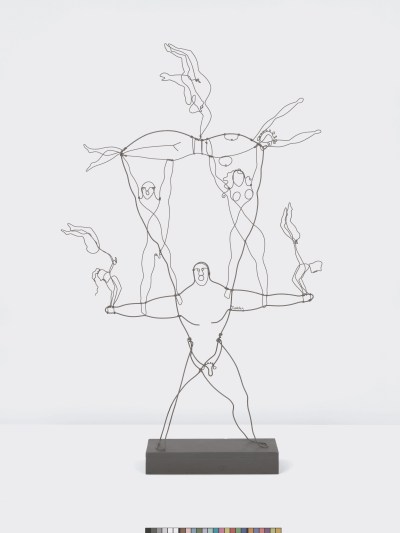
In 1926, amid the exuberance of the Roaring Twenties, Calder arrived in France and was immediately swept up in the currents of modernity, from Montparnasse to the Montmartre district. Artists such as Fernand Léger, whose portrait he sculpted in wire (1930), Jean Arp, Jean Hélion, Joan Miró, and Piet Mondrian welcomed him into their workspaces. In his Rue Daguerre studio, still considering himself a painter, he began developing the Calder Circus (1926–1931), a miniature construction of wire, fabric, and found objects animated before audiences—a playful yet rigorous exploration that already contained the characteristics of his future creations. The cast of this whimsical universe included a clothespin-headed dog, while broomstick, cork, leather, velvet, string, and a rubber tube combined to bring a horse and rider to life. Ultimately, the complexity of performing the Calder Circus led him to charge for his shows to raise the funds needed to pay his studio rent.
-
First Kinetic Sculptures

Image Credit: Collection of the Whitney Museum of American Art. Artwork copyright © 2026 Calder Foundation, New York/ADAGP, Paris. Digital image © Whitney Museum of American Art/Licensed by Scala/Art Resource, New York, courtesy of Calder Foundation, New York. By 1930 Calder sought to distance himself from what had brought him early recognition. His discovery of Piet Mondrian’s studio at 16 Rue du Départ in Paris that October acted as a catalyst for his turn toward nonfigurative art. Calder later recalled that the visit gave him “the shock that converted” him. This shift soon materialized in a series of nonobjective compositions, some of which were shown at the Galerie Percier in 1931.
In the fall of 1931, Calder produced his first kinetic sculptures. It was Marcel Duchamp who proposed the term “mobiles” to describe them. Some of these early works incorporated motors used to create controlled movements and introduce an element of calculated unpredictability. Gradually, however, Calder moved toward works activated by natural forces such as air currents, opening the system to chance and variability. In this context, forms could unfold through a potentially infinite number of configurations, shifting away from any fixed composition. Some critics have read his pursuit of expanded spatial perception and movement through space as an exploration of the “fourth dimension.”
InSmall Sphere and Heavy Sphere(1932–33), Calder conceived his first suspended mobile, activated by spectators and thus completed by them. They had to first arrange a series of objects around it—bottles, a tin can, a wooden box, a gong—and then quickly set a red iron ball in motion to trigger a sequence of free movements. Like a pendulum, the energy of the heavy metal sphere acts on a small wooden sphere, causing it to swing among the objects. Some critics have described the essential dynamic between spectators and the artwork in terms of a “fifth dimension.”
-
Return to New York

Image Credit: Collection of the Calder Foundation, New York. Artwork copyright © 2026 Calder Foundation, New York/ADAGP, Paris. Digital image: Tom Powel Imaging /Art Resource, New York, courtesy of Calder Foundation, New York.
In July 1933, Calder returned to New York with his wife, Louisa, aboard the SS Manhattan, in the company of Hélion. He would later establish a studio in Roxbury, Connecticut, which allowed him to collaborate with American patrons and institutions that supported the production and exhibition of his increasingly ambitious pieces. This period marked a shift toward a more organic style, in parallel with the biomorphic works of contemporaries Jean Arp and Joan Miró.
In the 1930s, Calder’s abstract pieces took on forms and movements reminiscent of plants and animals, a theme he would pursue over the next two decades in works including Steel Fish (1934), one of his first outdoor sculptures; Four Leaves and Three Petals (1939); Eucalyptus (1940); and Bougainvillier (1947). About Peacock (1941), philosopher Jean-Paul Sartre, its recipient, once said: “He gave me an iron-winged bird of paradise. It takes only a little warm air to brush again it as it escapes from the window and, with a little click, the bird smooths its feathers, rises up, spreads its tail, nods its crested head, rolls around, its wings outspread.”
-
New York and Paris

Image Credit: Private collection. Artwork copyright © 2026 Calder Foundation, New York/ADAGP, Paris. Digital image: Courtesy of Calder Foundation, New York. In 1937 Calder returned to Paris, where he set up a studio in a garage outfitted with an automotive turntable, likely to facilitate the viewing and adjusting of his sculptures. That same year, he was commissioned to createMercury Fountainfor the Spanish Pavilion at the International Exposition in Paris. The work included mercury mined in Almadén, Spain, a material that symbolized Republican resistance during the Spanish Civil War.It was shown alongside Picasso’sGuernica and Miró’sThe Reaper, reflecting the political engagement of these artists.
Back in New York in 1938, Calder began construction of a large studio on the foundations of an old dairy barn in Roxbury and shortly afterward converted the adjoining icehouse studio into a living space known as the “Big Room.” That same year, his first retrospective,“Calder Mobiles,” was presented at the George Walter Vincent Smith Art Gallery in Springfield, Massachusetts. The show included 61 pieces of jewelry, and among the guests at the opening were designer Alvar Aalto and painter Fernand Léger. A year later, Calder was commissioned by the Museum of Modern Art in New York to createLobster Trap and Fish Tail, a mobile installed in the principal stairwell of the museum’s new building on West 53rd Street.
Between the late 1930s and the early 1940s, Calder’s works were showcased at the Pierre Matisse Gallery in New York. The exhibitions included large-scale bolted stabiles, kinetic sculptures, and delicate pieces of jewelry—highlighting the breadth of his investigation of movement, balance, and material. In 1943, the gallery presented his first “Constellations,” a series of painted wood assemblages that marked yet another turning point in his career. Developed during the constraints of the Second World War, when access to metal was limited, the “Constellations” consisted of geometric and organic elements arranged in intricate networks, suspended, mounted, or placed on surfaces to create miniature universes. Each component’s position was essential to the piece’s rhythm and dynamic effect; improper placement diminished its visual impact. With these works Calder articulated a personal, almost cosmic vision, transforming his sculptural elements into an experience that engaged viewers both emotionally and spatially, bridging the tangible and the conceptual.
-
A MoMA Retrospective and Public Commissions

Image Credit: Private collection. Artwork © 2026 Calder Foundation, New York / ADAGP, Paris. Digital image: Art Resource, New York, courtesy of Calder Foundation, New York. That same year marked a decisive moment in Calder’s institutional recognition when theMuseum of Modern Artin New York mounted a major retrospective, organized byJames Johnson Sweeney. Bringing together works that ranged from early wire sculptures to recent abstract compositions, the exhibition established Calder as a central figure in modern art, framing his exploration of movement not as a marginal experiment but as a fundamental redefinition of sculptural practice.
After resuming his pendular life between Paris and New York and traveling from India to Venezuela, Brussels, Italy, and Spain, Calder became increasingly absorbed by major public commissions. His international stature was definitively affirmed in 1952, when he was awarded the International Prize for Sculpture at theVenice Biennale. By the late 1950s he was simultaneously engaged in three large-scale projects spanning two continents and relying on three foundries; the industrial and logistical complexity led him to joke that he felt like an important businessman. These works includedSpirale (1958), a monumental mobile destined for the UNESCO headquarters in Paris; .125 (1957), a 45-foot mobile for Idlewild Airport in New York (now JFK); andThe Whirling Ear(1958) for the Brussels World’s Fair, projects that together marked his definitive entry into architectural and infrastructural space.
-
Monumentality

Image Credit: Collection of Calder Foundation, New York. Artwork © 2026 Calder Foundation, New York / ADAGP, Paris. Digital image: Art Resource, New York, courtesy of Calder Foundation, New York. Between the early 1960s and the mid-1970s, Calder’s practice reached its full civic and monumental dimensions through a sequence of large-scale commissions.Teodelapio(1962), created for the Festival dei Due Mondi in Spoleto, Italy, stands approximately 65 feet high and marked the decisive translation of Calder’s mobile vocabulary into a fixed but dynamically balanced architectural presence. Its black steel structure preserves the sensation of movement through proportion, tension, and open form rather than actual motion.
During that period, Calder increasingly worked at the scale of cities and institutional environments.El Sol Rojo(1968), installed in the Zona Rosa district of Mexico City, rises to approximately 26 feet. It belongs to Mexico’s broader, late-1960s cultural modernization, shaped in part by the Olympic-era expansion of public art, and asserts a strong chromatic and symbolic presence within the urban landscape.La Grande Vitesse(1969), approximately 43 feet high and weighing around 42 tons, is widely regarded as the first major public artwork commissioned under the U.S. National Endowment for the Arts “Percent for Art” program. Installed on Calder Plaza in Grand Rapids, Michigan, it established a new model in which sculpture became a civic identifier and spatial anchor within downtown infrastructure.
In the 1970s, Calder’s monumental production intensified in both scale and architectural integration.Flamingo(1974), approximately 53 feet high and weighing about 50 tons, introduced a vivid red counter-form within Mies van der Rohe’s austere modernist Federal Plaza in Chicago, generating a deliberate tension between organic curvature and rationalist geometry. In the same year,Bent Propeller(1974), approximately 50 feet high, was installed in the newly developed World Trade Center Plaza in lower Manhattan, where it engaged directly with the vertical abstraction and monumental scale of the surrounding towers.
-
Final Years

Image Credit: AFP via Getty Images. At the end of his career, Calder left behind a series of unexpected projects that extended his work into the fabric of everyday life, including painted aircraft for Braniff (Flying Colors, 1973;Flying Colors of the United States, 1975) and a racing car (Calder BMW Art Car, 1975) and disrupted the monotony of ordinary experience. His grandson Alexander S. C. Rower today emphasizes that their apparent strangeness is central: They looked like nothing else, and that is precisely where Calder’s genius lies.
Newswire