
For the 20-plus years she lived in Athens, Georgia, Beverly Buchanan paid for everyday needs with artworks. Or some of them, at least.
A calendar with 12 hand-drawn self-portraits that she traded with her doctor, Dr. Stephen Lucas, opens “Beverly’s Athens,” a show on view at the University of Georgia’s Athenaeum through March 21. After visits, she’d pay him not with cash or co-pays but with art. They made the exchanges in the parking lot, as if illicitly.
Dr. Lucas lent works from his personal collection for the Athenaeum exhibition, and Buchanan’s personality radiates—in her use of line and color and in the provenance, as much as in her actual face. The show’s curators—artists Mo Costello and Katz Tepper, both based in Athens while working on the show; Tepper recently relocated—described the doctor’s house as basically a Beverly Buchanan Museum. In fact, every work they loaned for “Beverly’s Athens” is borrowed from “local collections”—a fancy way of saying that each lives in the homes and local businesses of ordinary people.
One work, however, resides in in the backyard of the shotgun house Buchanan once called home. There, she built a full-sized shack in the style of her by now iconic wooden works, and nurtured a verdant garden for which she earned her royal title: queen of Yellow Daturas—a psychoactive flower also known as jimsonweed. Archival footage of the garden captured by Judith McWillie shows blocky concrete sculptures among the plants, and the same works are on view nearby, mildly mossy; when the show is over, they’ll return to the yard. This is a show about place, and about the ecosystems—human and otherwise—that Buchanan tended to and that helped her thrive.
The blocks, untitled and undated, are just some of the sculptures Buchanan called “ruins,” “because I think that tells you this object has been through a lot and survived… it’s like, ‘Here I am; I’m still here!’” Indeed she is.
In the world of medicine, Buchanan was not only a patient. She earned two master’s degrees—one in parasitology, the other in public health—at Columbia University in the late 1960s. After graduating, she worked in the Bronx and in New Jersey, educating people on vaccination, breastfeeding, and birth control. All the while, she was making art, and in 1971 she enrolled at New York’s storied Art Students League. Soon, she met her mentor Romare Bearden, and by ’77, with the encouragement of her gallerist Betty Parsons, began pursuing art full-time. She moved to Georgia the following year.
There were works of hers that the gallery didn’t want to show. Namely: her flower drawings. (Imagine!) Buchanan would go so far as to hide them in the bathroom when her dealer came to visit. At last, they are on view. Yellow Daturas dangle defiantly from vines. In vases, tulips of brilliant crimson protrude as if with attitude.
The drawings join other works she made not necessarily for the New York art world, but for exhanges or out of love—like a Christmas tree concocted out of miscellany for a friend and, elsewhere, a gift for her plumber. Polaroids show an exquisite rocking chair, cobbled together both carefully and chaotically from scraps of wood, made for R.A. Miller, a beloved self-taught artist from Georgia. She is often taken for a self-taught artist herself—for her Southern charm, scientific training, and scrappy style—though Buchanan attended the Art Students League and anyway rejected the insider-outsider dichotomy. Rather, she wrote in 1988: “I think that artists in the South must at some point confront the work of folk artists,” adding that their work is “of and from the same place with the same influences, food, dirt, sky, reclaimed land, development, violence, guns, ghosts and so forth.”
The exhibition is earnest and touching, but it is far from naive. This is a show about survival as much as sentimentality. The curators, themselves chronically ill, placed special emphasis on Buchanan as a disabled artist, portraying her as a resourceful person crafting her own network of care outside of capitalism. A suite of drawings shows various healthcare angels: there’s an air-filter angel and a few hospital-gown angels. The back of one such drawing reads: “my other wing is being repaired. It’s almost good as new.” Other angelic notes express thanks to doctors and nurses and friends who cared for Buchanan when she, for instance, “ate weird food” and “had an allergic reaction,” per one self-portrait in a hospital bed. And in lieu of her beloved shack sculptures, we see the beds and chairs—the places of rest—that she created in a similar style.

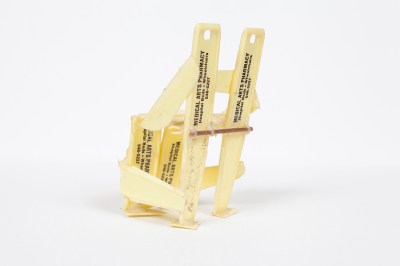
Among these is a chair made of compounding spatulas, used in certain pharmacies (including hers) to dole out doses often custom and precise. The pharmacy is a protagonist in ‟Beverly’s Athens”: the city’s Medical Arts Pharmacy—now Hawthorne Drugs—was and is more than simply a place to pick up prescriptions. Buchanan called it a “social, friendly place where you can eat lunch while waiting for your arthritis medicine.” A photograph she gifted the owner is signed with sass: “For my pharmacist, who I love very much… Yes, his wife knows.”
In the early ’90s, the pharmacy commissioned Buchanan to make a T-shirt shown here alongside a photo of her flaunting it, beaming. And at Hawthorne Drugs, the original drawing is still framed and hung lovingly on the wall. There, her tabletop Christmas tree rests on the prescription counter. When I visited, I understood immediately why she loved this place; Costello and Tepper are regulars, and by the time I left, the owner and I were on hugging terms. In a healthcare system whose business model seems to prioritize avoiding lawsuits over helping humans, the warmth of the place—that same warmth Buchanan clearly had a special knack for giving and receiving—made me nostalgic of the South and its sweet sides.
Beverly Buchanan epitomizes what we mean when we say “disability culture”: those creative, resourceful ways we collaborate to sustain ourselves and each other in a world not exactly built with our thriving in mind. This is always an art, even if it doesn’t always look like paintings and sculptures. But in her case, it does. I can’t help but wonder if traditional jobs remained accessible for her as she grew sick—before the Americans with Disabilities Act (1990) or anything like remote work; and if art was in some ways a more accessible job, customizable as it is. Certainly, trained in public health, she knew better than most that mere biomedical intervention is seldom sufficient—it takes a village, and she built the houses with her bare hands.
No wonder then that disabled artists—the ones who get it—have taken the lead in stewarding her legacy. Park McArthur, after all, co-curated her first big survey at the Brooklyn Museum in 2016, putting Buchanan in the spotlight.
Near the end of the Athenaeum show is a handwritten note that starts out “If I Won the Lottery.” Immediately, I wish she had; we would have all benefited. Her dream was to create “an ART hospital” where sick artists could rest, work, and receive care while making gifts for one another. Until that dream is realized, we revel in her gifts galore.