
The economy of Peru’s Sacred Valley has long been entwined with the seasons. Rural communities typically grow crops and raise livestock to sustain themselves and to barter with others, a process that necessitates an attunement with nature, its cycles, and how these patterns influence self-sufficiency.
This is particularly true for the Quechua communities, Indigenous peoples who have long worked for subsistence rather than state currencies. In recent years, health clinics, schools, markets, and transportation requiring residents to use cash have slowly eroded this way of life. Today, many Quechua men leave their communities to work in tourism, which offers an income and the opportunity to learn Spanish. Conversely, women often remain at home to care for children and farms, making them dependent on support from their partners and family members.
In 2009, the nonprofit Awamaki formed to aid communities around Ollantaytambo, Cusco, as they navigated this change. U.S.-based Kennedy Leavens and Miguel Galdo, of Peru,had worked together previously at a similar organization supporting 10 women weavers from Patacancha. When that project shuddered, the two decided to found Awamaki to maintain their support.
The nonprofit grew quickly, and today, it assists nine cooperatives, comprising 174 artisans and community members who work across craft and tourism. With collaboration at its core, Awamaki prides itself on sustainability and focuses on broadening its partners’ access to a diverse array of markets and economic opportunities.
In addition to financial changes, the climate crisis is rapidly transforming the ways of the Sacred Valley, which faces disproportionate impacts as glaciers melt and the water supply dwindles. “The shift towards having personal income, for our artisan partners, is not about replacing traditional livelihoods, but about widening the economic ground beneath them so they can move their families towards prosperity and build resiliency to the effects of climate change, all without leaving the community or traditional ways of life,” the nonprofit tells us.
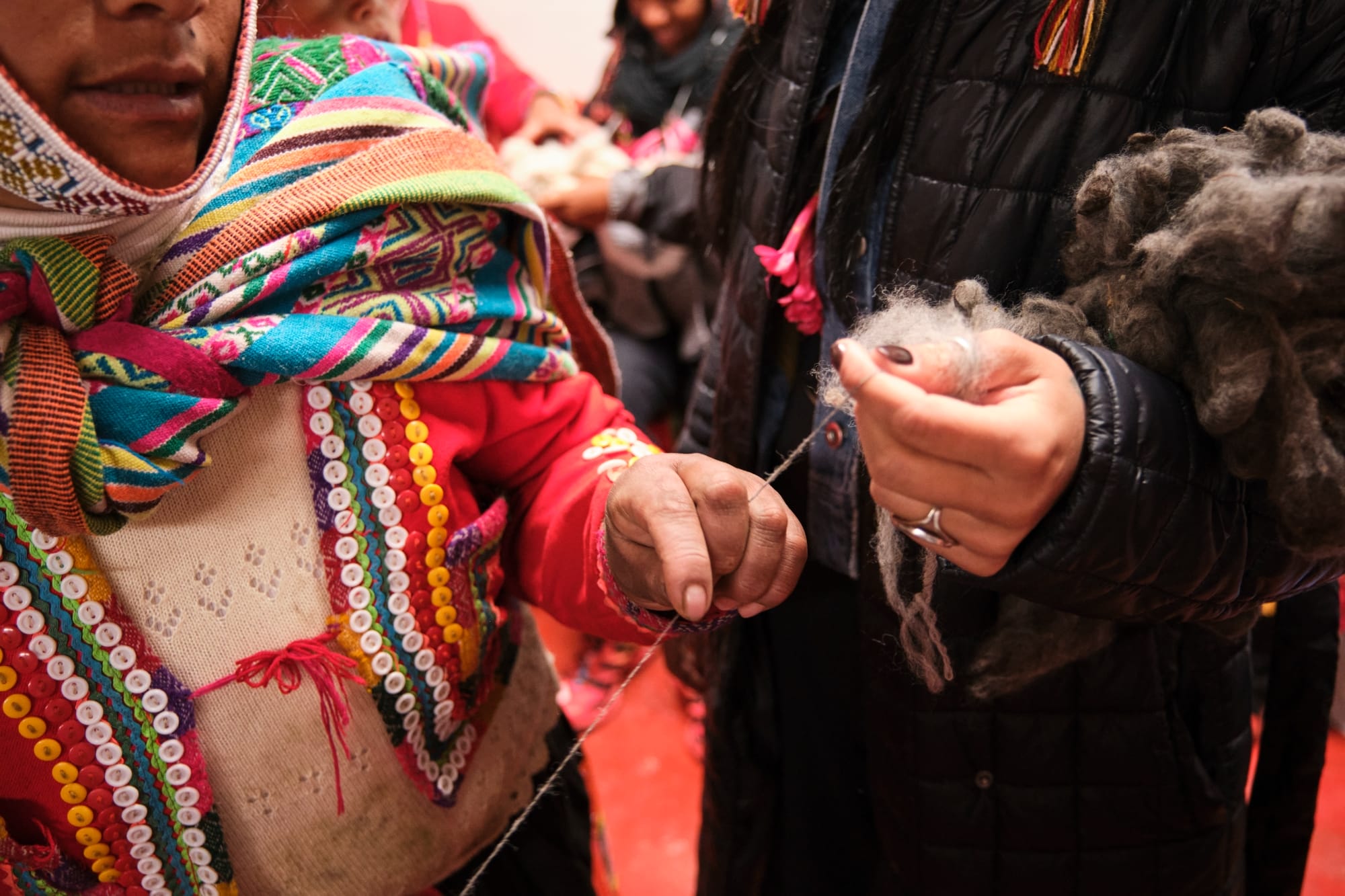
Partnering with Awamaki allows cooperative members to focus on traditional spinning, dyeing, and weaving traditions, while the nonprofit offers structural support in selling their goods and coordinating tourism. Carving through the terrain north of Cusco, the Andean highlands were once home to the Incans and still hold traces of the ancient empire, like the historic city of Machu Picchu, which continues to attract around one million people from around the globe each year. For many years, the organization says, visitors would arrive in villages without prior notice, and the women would halt their work to meet tourists and hopefully, sell a piece.
And of course, this way of making is demanding, as women not only weave, but also raise alpacas, shear their wool, and spin and dye the soft fibers into yarn. “Before weaving, I have to wash my hands carefully so the wool doesn’t get damaged. It requires attention and care,” Ricardina, an Awamaki member from the Cusci Qoyllur cooperative, tells us. “Sometimes I can weave more, sometimes less. It depends on time, on my children, on everything else I have to do.”
Today, Awamaki helps to coordinate tourism and provide compensation for visits. This includes programs like Murmur Ring’s immersion, which will bring a group of creatives to the region this June. “Our role is to create opportunities that can be compatible with cultural continuity, if that is what communities themselves want,” they say, adding:
For women, without personal income, everyday decisions can feel distant. Paying for school supplies, buying medicine, covering transportation costs, buying food to supplement the limited traditional crops that grow at high altitude–all of these depend on uncertain flows of money and shifting household dynamics. As climate patterns grow more erratic, with harsher frosts, longer dry spells, and thinning pasture, even the agricultural base families rely on has become less predictable, deepening that sense of financial fragility.
This regular support has simultaneously buoyed many women to greater financial independence and helped retain their way of life. “When new artisans join a cooperative, they are typically mentored by other women in their own community. Cultural knowledge remains community-held and community-led,” the nonprofit shares.

“In my family, we make decisions together—about how to earn and how to move forward,” Daniela, a weaver from the Puskariy Tika cooperative, says. “Through this work, we are able to keep going and improve our lives little by little.”
Nadia, of the Rumia cooperative, echoes this sentiment. “Being part of Awamaki changed things for us. Now we have a steady income, and that allows us to keep weaving,” she says. “In our community, it’s not always easy. Some people say, ‘Why do you weave?’ But they don’t understand this work… We also teach our children to care for the environment, to grow things, to respect the land. That’s part of our work, too.”
To learn more about the women and support their work, visit Awamaki’s website.


