
Editor’s Note:This story originally appeared inOn Balance,the ARTnewsnewsletter about the art market and beyond.Sign up hereto receive it every Wednesday.
It is officially March, which means I was back at the Windmill pub, just around the corner from Sotheby’s New Bond Street location, on Wednesday. My pre-sale pint before the house’s spring modern and contemporary evening sale has become a certainty in a world of uncertainties. I had only 15 minutes to neck it becauseDavid RothschildandJames Francis Fox, co-heads of private sales, had just given me a tour of “The Apartment,” a private exhibition of 11 works in one of Sotheby’s stately backrooms. Paintings by David Hockney, Luciano Fontana, and Helen Frankenthaler hung alongside furniture by designer and gallerist Rose Uniacke, all of it for sale. The art was valued at around £40 million all in; at the time of writing, five works had sold. One buyer had already signed off on an Andy WarholDollar Signwork and taken it away.
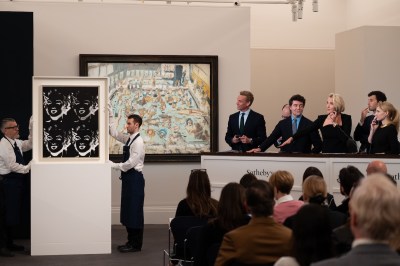
My tardiness meant there were no specialists to collar in the pub for intel; they were already flanking auctioneerOliver Barkeron the phones. When I slipped into the saleroom a few minutes late, it was packed with more than 300 people, and bidding on the opening lots was frenetic. The energy carried throughthe 54-lot sale,which achieved white-glove status—every lot sold (with one withdrawn beforehand). The total hit £131 million, or about $175 million, a few million shy of the high estimate, but no one seemed to mind. Team Sotheby’s was jubilant. (All prices include fees.)
A year ago, the equivalent sale brought in £62.5 million from 38 lots against a £66.6 million high estimate (about $83.6 million). Wednesday’s result marked a 110 percent increase.
“This is the first various-owner white-glove sale in my 22 years at Sotheby’s,” said a beamingAlex Branczik, head of modern and contemporary art, Europe, in the press room afterward. “The sale was underpinned by three collections: the Lewis Collection and two other private collections from Germany and Italy. Quality drives bidding.”
The first three lots set the tone: Josef Albers’sStudy for Homage to the Square: Gobelinsold for £1.1 million (high estimate £830,000). Another WarholDollar Signmade £770,000 (high estimate £570,000). Warhol’sFlowersbrought £2.4 million (high estimate £1.7 million).
Were celebrations tinged with relief? A few hours before the auction,Jussi Pylkkänen, Christie’s former CEO and founder of Art Pylkkänen, reminded me that “war creates uncertainty,” citing the bombs raining down on Iran and retaliation across the Gulf. “Any major conflict impacts bidding,” he said, pointing to market drops during the Iraq War in 2003 and after Russia’s invasion of Ukraine just under 20 years later. Art adviserPernilla Holmesof London-based Wedel Art echoed the cautious mood.
If Sotheby’s felt jittery, it didn’t show. “We haven’t lost a single pre-sale bid,” a spokesperson said before launch. Buyers kept spending. Warhol’sFour Marilyns (Reversal Series)sold for £4.3 million against a £3.2 million estimate. Fernand Léger’sLes Hommes dans la Villefetched £4.8 million.

It got better. Leon Kossoff’sChildren’s Swimming Pool, 11 o’clock Saturday Morning, Augustsold for £5.2 million after a 10-bidder battle, obliterating its £800,000 estimate and setting a new auction record—20 times its 1992 price at Sotheby’s. Sold through Asia chairman Wendy Lin, it was one of four School of London works from the Lewis Collection, consigned by businessman Joe Lewis.
I asked Pylkkänen if the distinct lack of wet-paint artists in the sale reflected the market’s mood. “The wet-paint market is going through a revision, it’s being reassessed by major collectors, who are leaning more on classic canon artists. Tonight’s material is deep and rich, it’s all very positive. You can also expect some good things coming up in the May sales,” he said. You heard it here first.
Claude Monet’sMaison du Jardiniermade £8.2 million (estimate £8.5 million). “This is going quite well,” grinned honorary chairmanHarry Dalmenyas the hammer fell. CEOCharles Stewartagreed: “It’s shaping up to be the best Spring London sales we’ve had.”
Lucian Freud’sA Young Paintersold for £7.1 million, above its £6 million estimate. Then came Francis Bacon’sSelf-Portrait. Bidding opened at £7 million and climbed past its £12 million estimate, finally selling for £16 million to wild applause.
What didThe Baer Faxt’sJosh Baerthink about proceedings? “Retail therapy,” he told me. “No jangling nerves on account of the Middle East pandemonium,” I offered. “It always goes the other way,” he replied. In the midst of chaos, there is also opportunity, a great man once said. Afterwards, I asked Branczik if he agreed with Baer. “The art world is fairly well insulated, at least in the short term,” he said. “Just look at what happened the day Lehman Brothers collapsed in 2008—Sotheby’s sold over £100 million of Damien Hirst’s work here in London.”
Other standout results on the night included Frank Auerbach’sStudy for a Tree on Primrose Hill(£704,000), Constantin Brâncuși’sUne Muse(£3.9 million), and Vilhelm Hammershøi’sThe Balcony, which sold for £1.8 million. Alberto Giacometti’sFemme deboutalmost doubled its high estimate, selling for £5 million.
Christie’s now has a tough act to follow on Thursday in London. It’s hosting a three-pronged evening sale, starting with the 20th/21st Century evening sale and followed by “Art of the Surreal” and “Modern Visionaries: The Roger and Josette Vanthournout Collection.”
Before Wednesday’s sale, I askedKeith Gill, Christie’s head of Impressionist and modern art, if he had any concern about the conflict in the Middle East impacting bidding. “We’re not seeing any impact at this stage,” he said. “The view was extremely busy over the weekend and remains so today—phone activity and general interest are on par with October, if not stronger. Of course, events are affecting some of our clients and colleagues personally, but in market terms we haven’t seen a slowdown.”
There are several standout lots across Christie’s three sales. The top one is no doubt Wassily Kandinsky’sLe Rond Rouge, which has a £15.5 million high estimate, or about $21.3 million. It last sold eight years ago,for $20 million, when it appears to have been acquired by Swiss billionaireGeorg von Opel, who has now consigned it for sale.
In September, Christie’s filed a Uniform Commercial Code financing statement securing several artworks from Hans Aktiengesellschaft, an investment company owned by von Opel. Among the works listed was the Kandinsky, as well as pieces by Fernand Léger, Gerhard Richter, and Roy Lichtenstein, thelatter of whichappears to have sold at a Christie’s day sale in November. Christie’s declined to comment in September, and Hans Aktiengesellschaft did not respond to requests.
Also headlining Christie’s 20th/21st Century evening sale is a fresh-to-auction Henry Moore sculpture titledKing and Queen(1952–53). The 64-inch-tall bronze carries a £15 million ($20.5 million) high estimate.Katherine Arnold, Christie’s vice chairman of 20th/21st century art and head of post-war and contemporary art for Europe, toldARTnewsthat the bronze is “the most exciting sculpture I’ve ever seen brought to market.”