
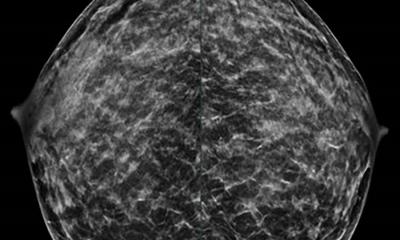
Spot on right mediolateral oblique (side angle) view. Area of distortion persists on additional mammographic views, and a mass is identified on subsequent breast ultrasound. Ultrasound guided biopsy was performed and revealed nuclear grade 1 invasive ductal carcinoma.
Image credit: Stamatia Destounis, M.D., and RSNA
Dr. Destounis noted that an important factor about the research is that the numbers stayed remarkably stable over the study period, even though fewer young women may have been seen overall, the absolute number of breast cancers in this group did not decrease. “That means this problem is not going away,” she said. “It is here to stay and needs to be addressed on a larger scale. Research such as this supports earlier and tailored screening to allow for earlier detection and better treatment outcomes. This data reinforces that women under 50, especially those under 40, shouldn’t be seen as ‘low risk’ by default and can absolutely benefit from risk assessment being performed as early as possible.”
Dr. Destounis cautioned that younger patients should be informed to be aware of changes in their breasts and to start screening in certain cases. “Those with a strong family history or genetic mutation, as well as certain minorities and ethnic backgrounds, are at higher risk for breast cancer at a younger age,” she said.
Dr. Destounis emphasized that the biggest takeaway of the study is that breast cancer in younger women is not rare, and when it does occur, it is often more serious. “We can’t rely only on age alone to decide who should be screened,” she said. “Paying closer attention to personal and family history, and possibly screening earlier for some women, could help detect these cancers sooner.”
Source: Radiological Society of North America