
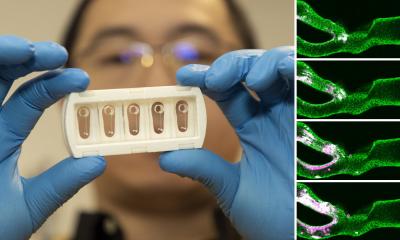

Charles Zhao examines the ‘artery on a chip’.
Image credit: University of Sydney/ Fiona Wolf
Cardiovascular disease is currently the leading cause of mortality in Australia, with one person losing their life from heart disease approximately every 12 minutes. Although there are well established diagnosis methods for cardiovascular diseases, there is no method to predict early events that lead to blood clots in carotid arteries.
“We’re not just printing blood vessels – we’re printing hope for millions at risk of stroke worldwide. With continued support and collaboration, we aim to make personalised vascular medicine accessible to every patient who needs it,” said PhD candidate Charles Zhao from the School of Biomedical Engineering, Faculty of Engineering. Charles’s background is mechanical engineering but was inspired to take up a PhD in biomedical engineering to create something with more human impact. His knowledge in fluid dynamics was invaluable when applied to studying blood flow in blood vessels.
The model re-creates anatomically accurate replicas of healthy and diseased areas of blood vessels. This includes delicate blood vessel anatomy, and dents and divots on the damaged lining of the blood vessel wall, a pathology commonly seen in stroke patients.
Researchers used CT scans of stroke patients as blueprints to create mini models, shrinking the original carotid artery 3D model to 200 to 300 micrometers. A full-sized carotid artery is 5 to 7 mm. The researchers were also able to ‘shrink’ the manufacturing time from 10 hours to two hours.
Traditional 3D printing moulds use resin, which is time consuming and has a high error rate. But the researchers developed a new method that uses glass slides as a base. From a distance, the blood vessels look like delicate engravings on glass. “When it comes to heart attack and stroke diagnosis, speed and accuracy is key,” says Charles who is the first graduate student and founding member of the Mechanobiology and Biomechanics Laboratory (MBL). “Clinicians typically have an approximately 12-hour decision-making window after symptom onset.”