
Professor Grunwald continued, “Questions had been raised about the cost-efficiency of MSUs and how they could be integrated into clinical practice but this study shows clear benefits to their widespread adoption across the country. This research shows that the MSU concept may benefit from equipping them with extended capabilities that make them suitable for dealing with additional emergencies, particularly in non-urban areas.
Mobile Stroke Units Could Transform Emergency Care in Scotland
“If MSUs were supported and funded across Scotland then the impact on patient flow, hospital capacity and emergency care would be transformative, reducing unnecessary admissions, freeing thousands of bed-days, and easing pressure on overwhelmed emergency departments. Even a single MSU could prevent around 600 unnecessary admissions every year, saving 3,000–3,600 bed-days and around £1 million annually. For elderly and frail patients in particular, this means safer care, fewer hospital stays and being triaged to the right place at the right time.”
Dundee Leads Global Innovation in Stroke Treatment
The study was led by Consultant Neurologist Professor Silke Walter (University of the Saarland), with strategic leadership from Professor Klaus Fassbender, CEO of Intelligent Ambulance Solutions (INTAS) and the inventor of the MSU/ and Hybrid-MSU concepts. The operational work was supported by Professor Grunwald and PhD student Daniel Phillips, a Consultant Paramedic with the East of England Ambulance Service, who evaluated the MSU pathway. Professor Grunwald served as lead for imaging, frequently accompanying the MSU, and later providing teleradiology support, assisted by Drs Saman Perera, Jineesh Thottath (Southend University Hospital) and Avinash Kannodia (NHS Tayside). Also contributing were the East of England Ambulance Service, East Suffolk and North Essex NHS Foundation Trust, and Fred Heddell, Director of the Mobile Stroke Unit Charity, whose long-standing commitment was central to establishing the service evaluated in this study.
Groundbreaking Robotic Thrombectomy Achievements
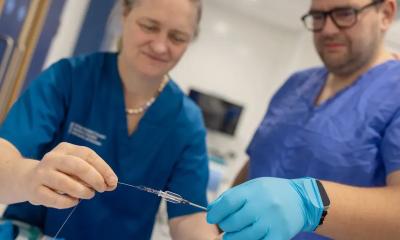
Dundee’s position as a global leader in stroke treatment and training was bolstered in October when Professor Grunwald and colleagues took part in the world’s first robotic transatlantic thrombectomy. The event came hours after she performed the first-ever remote thrombectomy on a human cadaver. Using a cutting-edge robot developed by Lithuanian MedTech company Sentante, Professor Grunwald proved that a blood clot could be removed from the brain without a specialist being physically present when she performed the procedure from a remote site within the School of Medicine at Ninewells Hospital. That was followed by the groundbreaking moment when Sentante’s device was used to perform the first transatlantic thrombectomy on a human cadaveric model located at Dundee from Jacksonville, Florida.
Source: University of Dundee