
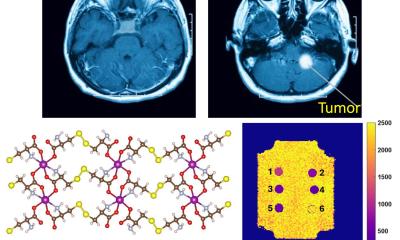
There is also risk, Stylianou said, from gadolinium retention in the body. Most agents are designed to be excreted within 24 hours of administration, but even in patients with normal kidney function, gadolinium can stay in tissues for months or years. Retention hasn’t been conclusively linked to disease, but the Food and Drug Administration has issued warnings and requires patient education because of uncertainty regarding long-term consequences.
BVR-19 is the first manganese-based MOF to incorporate L-cystine, a naturally occurring, biocompatible amino acid, Stylianou said. Its synthesis takes place in water at room temperature, no toxic solvents or other harsh conditions are required, and tests show that it allows for brighter, clearer images at lower doses than required of current commercially available agents. “This work underscores OSU’s leadership in designing functional MOFs for medical and environmental applications and demonstrates how green chemistry and materials design can converge to create safer technologies,” he said. “It bridges chemistry, toxicology and medicine, showing how collaboration across disciplines can transform fundamental discoveries into technologies that directly improve human health.”
Doctoral student Jacob Lessard and undergraduate Dylan Pyle were first authors of the study, which was published in the Journal of Materials Chemistry B. Other contributing members of the MaD Lab were postdoctoral fellow Andrzej Gladysiak, doctoral student Emmanuel Musa and undergraduate Jeff Bowen. The collaboration also included Robyn Tanguay, Lisa Truong and Siva Kolluri of the OSU College of Agricultural Sciences and Cory Wyatt of Oregon Health & Science University.
Funding was provided by OHSU and the OSU Research Academy.
Source: Oregon State University