
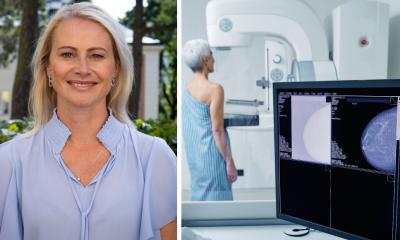
Image source: MedUni Wien
The session also heard from Professor Pascal Baltzer from the Department of Biomedical Imaging and Image-guided Therapy at Vienna General Hospital who looked at AI in screening from the perspective of the latest trials. He said a key factor in AI in screening was the shortage of radiologists and a rising workload, though he also noted that digitalisation has allowed radiologists to be faster in reporting. He also pointed to a UK workforce census that indicated a 29% shortfall in radiology consultants at a time that imaging demand was growing by 8%.
However, while AI has potential for improved cancer detection and workflow efficiency, he warned of a risk of “over-enthusiasm” and that robust evidence is needed.
He discussed a number of trials including a meta-analysis comparing AI screening with radiologists, the MASAI and ScreenTrustCAD trials from Sweden, alongside studies from Denmark, Germany, Hungary and South Korea, comparing AI systems to radiologists’ performance. In a summary of the evidence for AI in screening, he said it is regularly superior for cancer detection; that recall and false positives were stable or reduced; there is a significant workload reduction; but evidence is still short-term on interval cancers and overdiagnosis.
Giving his final verdict, Baltzer told delegates: ‘AI is ready to assist, not yet intended to replace radiologists but the evidence supports use of AI in screening very clearly. The next step is the interval cancer data and legal clarity is also needed but these are all processes where radiologists should be integrated as much as possible.’
Profiles:
Dr Karin Dembrower is the head physician at the Department of Breast Radiology, Capio Sankt Görans Hospital in Stockholm and has been working as a dedicated breast radiologist since 2016. Her scientific work is focused on assessing how AI can be implemented to improve cancer detection and breast cancer risk estimation.
Pascal Baltzer is Professor for magnetic resonance radiology at the Medical University of Vienna and has been a radiologist at the Department of Biomedical Imaging and Image-guided Therapy at MedUni Vienna since 2012. His scientific focus is on magnetic resonance imaging (MRI) and he is internationally-recognised for his work on breast, bladder and prostate imaging.