
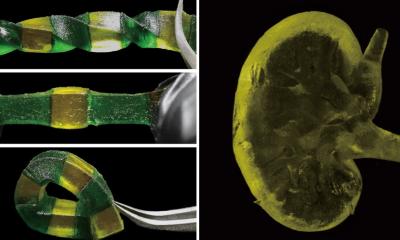
We can change the shape of the UV lights to create so many complicated structures
Baiqiang Huang
To create this stretchiness, the team built upon existing work from Cai’s lab, which had already developed a way to create very strong synthetic polymers. The approach took a page from the methods used to create stretchy, strong rubber: store length in internal structures at the molecular level. These internal structures, called a “foldable bottlebrush” design, make for a material that can be both very strong and very stretchy. The polymeric molecules have many flexible side chains radiating out from a central backbone that can collapse like an accordion — storing extra length that can be unfolded. “Our group discovered this polymer and used this architecture to show any materials made this way are very stretchable.” Cai said.
To create the new material, Huang applied the foldable bottlebrush polymer concept to PEG. He exposed the precursor mixture to ultraviolet light for a few seconds, which initiates polymerization to form a bottlebrush-architecture network. This resulted in 3D-printable, highly stretchable PEG-based hydrogels and solvent-free elastomers. “We can change the shape of the UV lights to create so many complicated structures,” Huang said, including structures that are either soft or stiff but remain stretchy by design. This type of versatility in design could one day allow for the creation of new techniques for creating artificial organs or delivery medicines.
The paper also shows that the stretchy 3D-printable PEG materials are biologically friendly. The researchers cultured cells alongside the materials, to make sure they can live side-by-side, and they were compatible, Huang said. This is good news for its potential use for materials that would go inside the body, such as scaffolding for an organ.
The paper’s other authors include UVA Engineering colleagues Myoeum Kim, Pu Zhang, Emmanuel Oduro and Daniel A. Rau. The work was funded by the National Science Foundation, National Institutes of Health, UVA LaunchPad for Diabetes and Virginia Innovation Partnership Corporation’s Commonwealth Commercialization fund.
Source: University of Virginia School of Engineering and Applied Science