
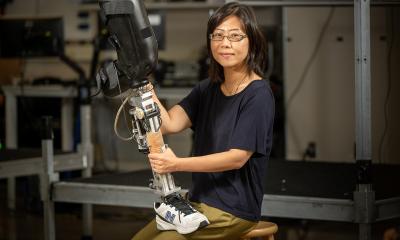
Incorporating the new algorithm improved hip range of motion for all five subjects, which demonstrates that it can make a difference for hip health
Varun Nalam
The robotic prosthetic knee incorporates sensors to track its movement. In proof-of-concept testing, the researchers also focused on the user’s hip movement, which was monitored via sensors connected to the wearer. “The new algorithm essentially accounts for the movement of both joints – the prosthetic knee and the user’s hip – and adjusts the behavior of the prosthetic knee to help the user exhibit their natural hip movement,” says Nalam. “While we focused on hip movement for this study, the algorithm could also be used to help users with trunk movement, walking symmetrically or other aspects of human performance,” says Huang.
To test the new algorithm, the researchers recruited five study participants: two participants were people who had an amputation above the knee, three participants had not had an amputation. All five study participants performed a series of tasks using a robotic prosthetic knee under two different conditions. In the first condition, the knee was operated using software that incorporated only the earlier system for knee control. In the second condition, the software incorporated the new combination of algorithms.
“The main finding here was that incorporating the new algorithm improved hip range of motion for all five subjects, which demonstrates that it can make a difference for hip health,” says Nalam. “We also found that the new algorithm changed the gait of our study subjects in ways which indicate that movement felt more natural for users. For example, they took longer steps when walking.”
“From a practical standpoint, next steps include working with clinicians to see how it affects user well-being over time,” says Huang. “We’re also interested in working with companies that make robotic prosthetics to explore questions associated with incorporating this approach into their software.”
“From a research standpoint, we are interested in determining how this approach can be used to help address a range of human locomotive behaviors,” says Nalam.
Source: North Carolina State University