
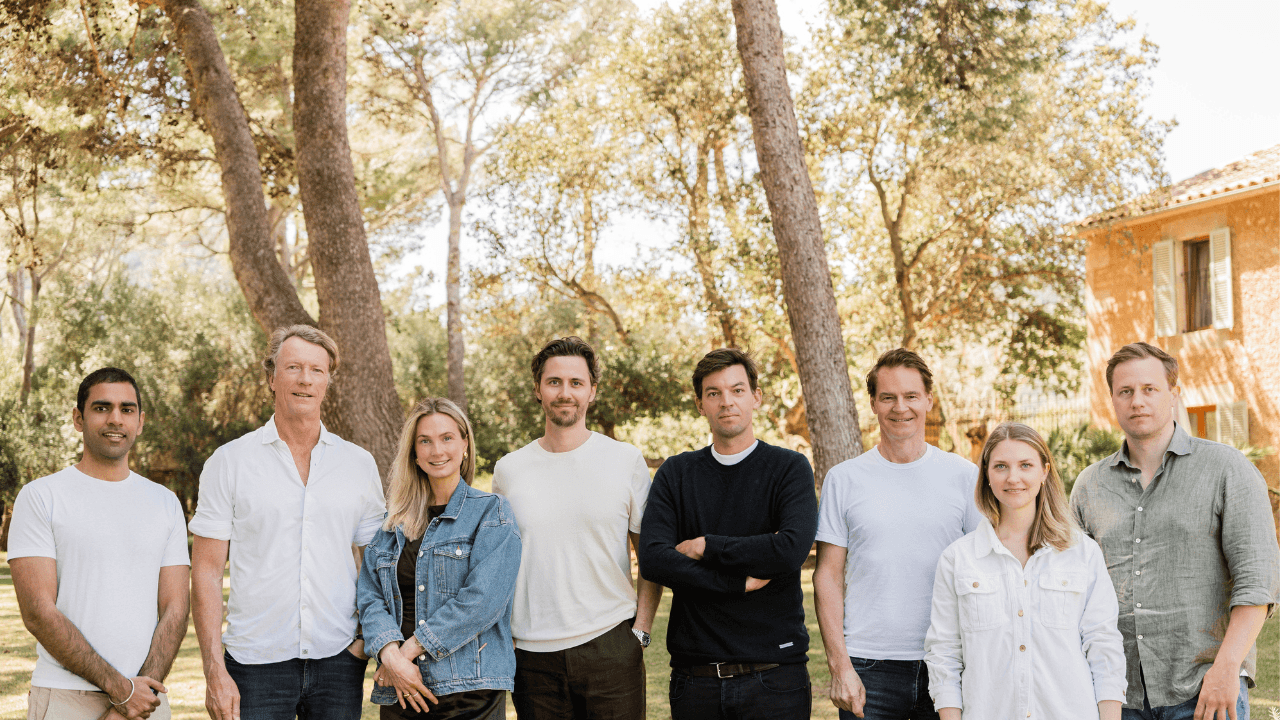
Earlybird VC has closed its eighth early-stage fund at €360 million, marking the largest raise in the firm’s history and reinforcing its fundraising momentum, which it has maintained through both bull markets and downturns.
Backed by a mix of large institutions and family offices, the fund continues a nearly three-decade track record of raising new capital every three to four years without exception.
Across its technology investment strategies — including Earlybird Health and multiple growth vehicles — the firm now manages €2.5 billion in assets.
I spoke to Partner Dr Andre Retterath to learn more.
Dr Andre Retterath joined Earlybird VC’s Munich office in 2017, where he leads the firm’s AI and infrastructure investment practice, focusing on frontier models, developer tools, and software infrastructure. He sits on the boards of companies, including Aleph Alpha,Energy Robotics, Ethon.AI, Sintra AI, spAItial, and SLNG, among others, and leads Earlybird’s Flywheel team supporting portfolio growth across engineering, marketing, and community.
Early bets from Fund VIII
The first deployments from Fund VIII reflect Earlybird’s focus on AI infrastructure, vertical applications, and foundational technologies emerging across Europe. From the new fund, Earlybird has already backed promising companies such as Black Forest Labs, SpAItial AI, Sintra, Arago, Porters, and Rivia.
A number of stealth and new investments will be announced.
Where value is really accruing in the AI stack
Earlybird invests across AI applications, infrastructure, and foundational models, and I was interested in where they see the most value accruing in the AI stack right now.
According to Retterath, Earlybird’s thesis has evolved quite significantly over the past few years. He contends that if you look at the application layer, many companies operate with very thin margins — often negative.
“Foundation models tend to sit somewhere in the 30 to 50 per cent range. But when you move further down the stack, into infrastructure and hardware, margins are materially higher — Nvidia is the obvious example, running at 70–75 per cent.”
The deeper you go in the stack, the higher the barriers to entry and the stronger the defensibility. He asserts:
“At the application layer, it has never been easier to build a product — you can spin something up over a weekend.
The constraint has shifted from building to distribution. So while applications are noisy and highly competitive, infrastructure offers stronger moats.
The risk at the top of the stack is that you can be replaced very quickly — sometimes within weeks.”
How Earlybird built an edge by backing deeptech before it was obvious
That same logic — favouring deeper, more defensible layers of the stack — has long shaped Earlybird’s investment strategy.
It’s what led them to recognise Isar Aerospace long before space tech was on the radar, and to Marvel Fusion when laser-based nuclear fusion was mentioned only in academia. Both are now benchmarks of European frontier technology.
Retterath attributes this to the firm’s approach to technology. It’s always focused more on technology-differentiated businesses than on purely business-model innovation.
Many of the Earlybird partners come from technical backgrounds in areas like aerospace and industrial engineering, which shapes how they see opportunities.
Before joining Earlybird, Retterath worked as a process automation engineer at ThyssenKrupp and as a management consultant with GE North America. He holds a PhD from the Technical University of Munich, focused on machine learning and venture capital, alongside degrees in management and mechatronics, and has studied at Harvard University, the University of Cambridge, and the Georgia Institute of Technology.
That technical grounding shapes how Retterath identifies and backs complex, high-barrier technologies ahead of the market.
He contends that Earlybird started building its AI investment practice years before it became mainstream:
“There are two ways to differentiate: through technology and through the business model.
We are probably 90 per cent focused on the former and 10 per cent on the latter. That’s why we’ve consistently leaned into specific sectors, industries, and technologies very early on. That allowed us to develop conviction early. “
To Retterath, early investment is crucial to accessing founders:
“In highly competitive rounds, founders don’t just choose capital — they choose partners. If you’ve built credibility over time, founders will come to you earlier.”
Retterath invested in DeepCode, a Swiss startup using machine learning to analyse code and automatically detect bugs, vulnerabilities, and performance issues, which was later acquired by Synk in 2020.
Further, he closely tracked the foundation space, which led to an early investment in Aleph Alpha. Through that network, he also learned that Matthias Niessner was leaving to start Black Forest Labs — an opportunity Earlybird would go on to back at a very early stage in 2024.
Earlybird restructures for generational continuity and long-term independence
Building challenger companies takes decades, and Earlybird VC is reshaping its own structure accordingly.
With the close of Fund VIII, the firm has implemented what it calls a “perpetual active ownership” model — a generational approach designed to ensure long-term continuity without external ownership.
Nearly three decades after founding Earlybird, co-founders Dr Hendrik Brandis and Dr Christian Nagel, alongside partners Paul Klemm, Tim Rehder, and Dr Andre Retterath, have formalised a structure in which ownership remains exclusively with active partners and is continuously passed on to the next generation.
As part of the transition, Jochen Küst also assumes the role of Operating Partner in addition to his CFO responsibilities.
At a time when several European VC firms are exploring partial exits or external ownership, Earlybird is taking a different route. The firm will not be sold, nor will it bring in outside shareholders. Instead, ownership is tied directly to operational responsibility: once a partner steps back, their shares are transferred to the remaining partners.
For Retterath, the model is as much about access and incentives as it is about governance.
“In many VC funds, becoming a partner requires significant GP commitment, which often means you need to come from a wealthy background or have already made money. That creates a structural barrier.”
Earlybird’s approach removes that constraint. The firm aims to ensure that ownership is not gated by personal wealth, but instead tied to merit and long-term contribution.
“We want to enable the best investors — no matter their background, education, or gender — to be in a position to build Earlybird.”
The second issue is retention. Without a clear path to leadership, top investors eventually leave — a pattern seen across more established firms.
“If you can’t present a clear trajectory — how someone becomes a true leader and eventually runs the firm — they will leave. You can only do that so many times before it becomes a problem for the firm and its LPs.”
The model emerged from a broader reflection on succession — a topic Retterath argues is still largely unresolved across European venture. After benchmarking around 15 leading firms, he discovered that to no surprise, “there was no blueprint.”
“Most firms haven’t really solved this. Often it’s still one or two founding partners in the driver’s seat, without a clear transition plan.”
That led to a fundamental question: Should Earlybird eventually be sold — or built to endure?
“Do we want to be sold — like many firms have been — or do we want to create something that lasts? A firm that’s always on?”
The answer was clear: “We want to create a legacy. We do not want to sell Earlybird — and we expect that it never will be.”
Under the perpetual ownership model, only active general partners can hold equity. There is no buy-in requirement, and equally, no ability to cash out. Ownership is passed forward — not monetised.
“As long as you’re an operational general partner, you can be an owner. Once you retire, you step out and hand over your shares to the next generation.”
The result is a structure designed to align incentives across decades — not fund cycles — while giving rising investors a clear path to leadership.
“For the next generation, this creates real clarity. They know exactly what they are working towards — becoming an entrepreneur leading the firm.”
In an industry often defined by short-term cycles and opaque partnership dynamics, Earlybird is making a deliberate bet: that long-term ownership, clearly structured succession, and open access to partnership will be a competitive advantage — not just for the firm, but for the founders it backs.
Scaling into the next phase of European tech
Fund VIII builds on decades of experience and an AI-native team with boots on the ground across Europe’s major hubs.
“The majority of our LPs have backed us across several fund generations, and with our perpetual ownership model in place, it’s our mission to keep evolving without losing sight of the principles that have brought us to where we are today,” shared Retterath.
Europe is entering a new chapter, with AI accelerating the transformation of entire industries. Earlybird embarks on a new era that combines three decades of experience with a next generation of partners ready to back exceptional teams across AI applications, software infrastructure, and deeptech.
Retterath is bullish about Europe’s future. He contends that the geopolitical developments that have forced Europe to take sovereignty more seriously are creating momentum across technology, infrastructure, and capital.
“Europe has the talent, the research base, and increasingly the capital to build globally relevant companies.
Historically, European startups have also been more capital-efficient, which is an advantage. So overall, I think we’re entering a very strong phase for the European ecosystem.”