
AI Chamber, in
partnership with The Recursive Media and with support from Europe Cloud, has
launched the CEE AI Index 2026, a new research initiative designed to measure
the strategic AI readiness of countries across Central and Eastern Europe.
Covering 11 countries,
the index evaluates the structural ability of nations to develop, deploy, and
host artificial intelligence efficiently, safely, and within established
governance frameworks.
The assessment is based on 33 indicators and 363 data
points across three categories: Environment (which measures governance and
digital infrastructure), Resources (which evaluates talent and investment
ecosystems), and Deployment (which examines AI adoption and research output).
The findings suggest
that while the region is more advanced in AI readiness than is often assumed, a
growing divide is emerging between countries that are positioned to help shape
Europe’s AI landscape and those that are still building the foundations required
to participate fully.
According to the
index, success is not determined by size alone. Several smaller countries
outperform larger economies through targeted investments in governance, talent,
and digital infrastructure.
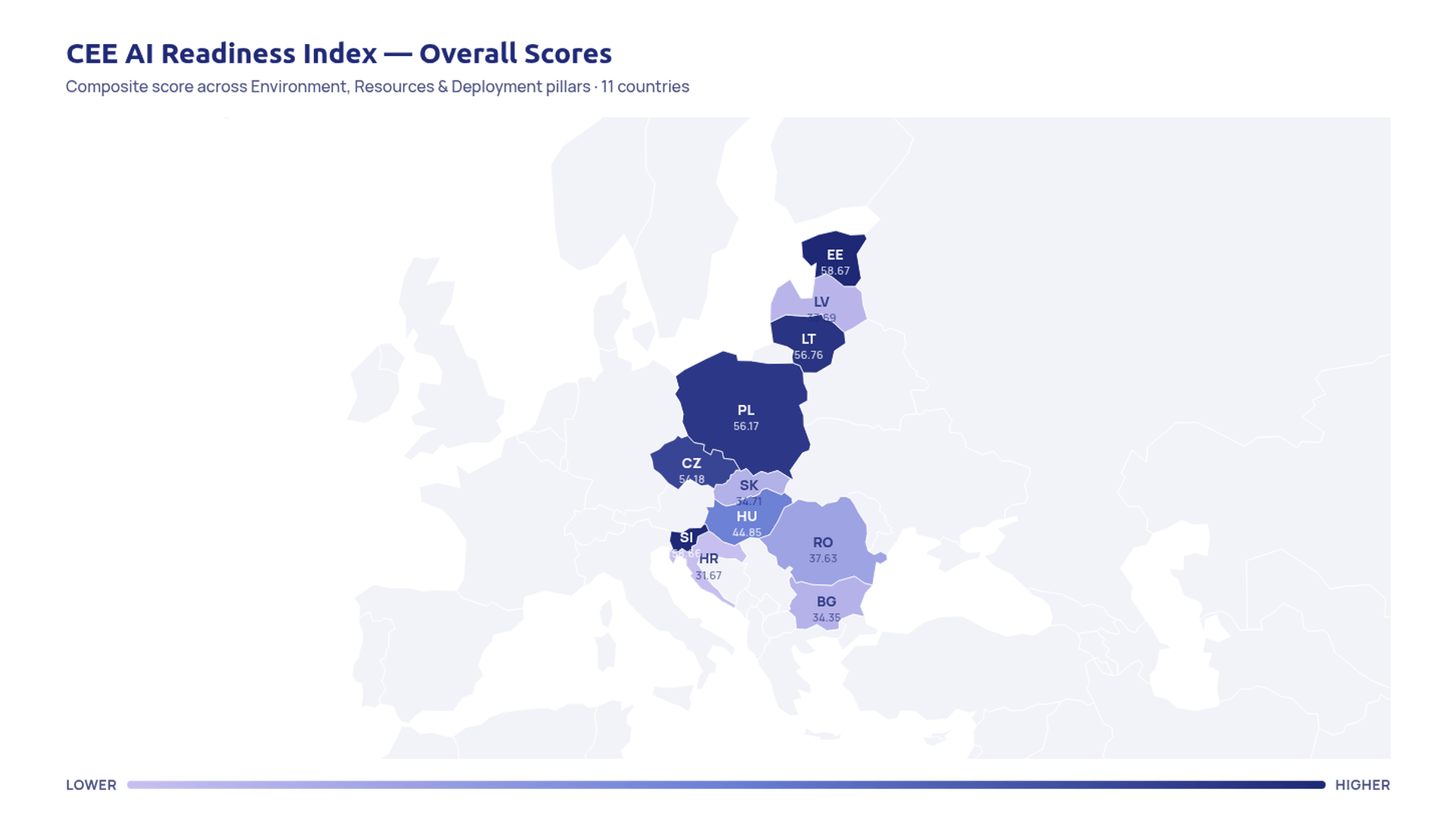
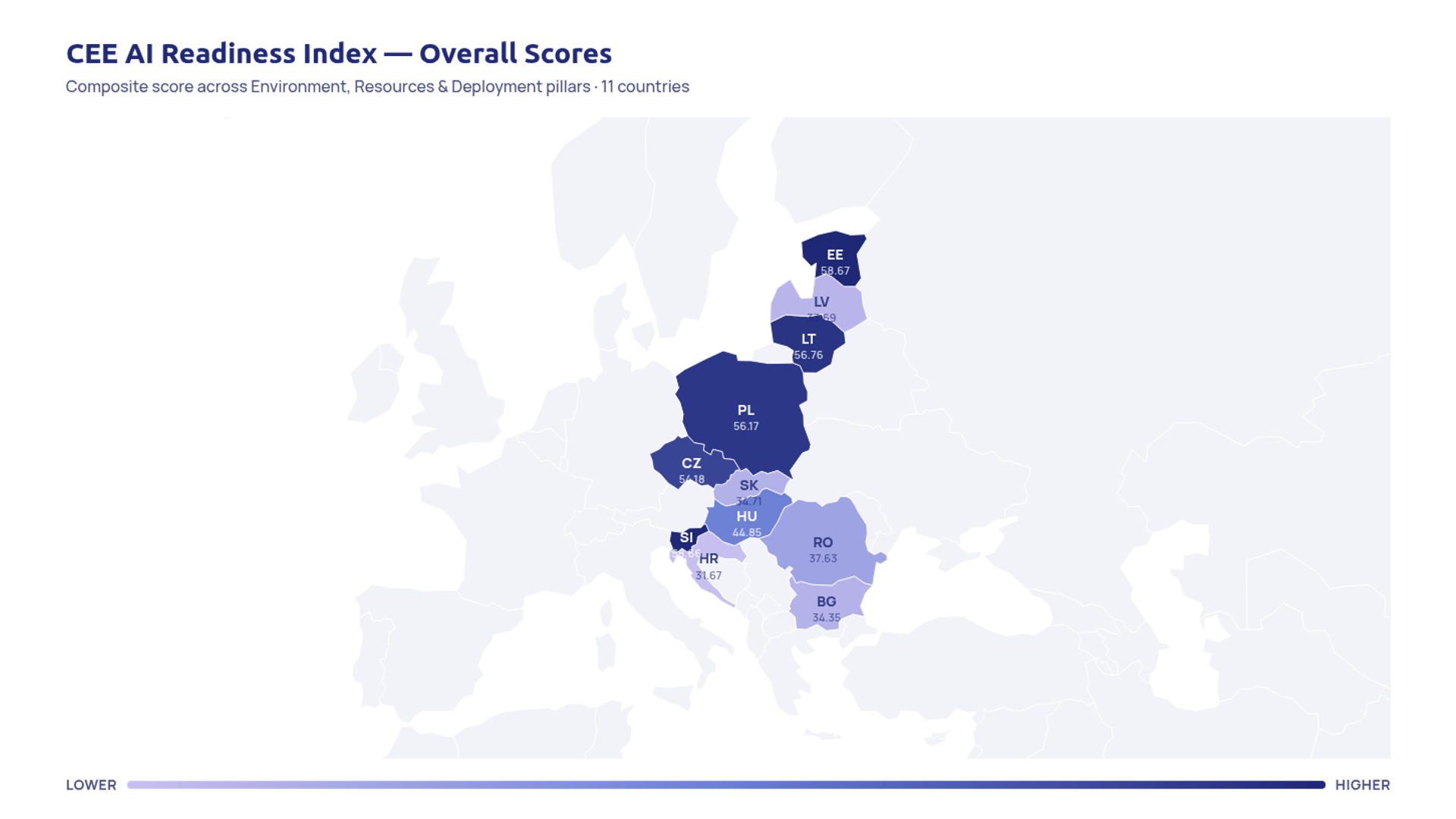
Estonia emerged as the region’s most
institutionally mature AI ecosystem, combining advanced digital public
services, strong enterprise adoption, and a high concentration of AI talent.
Lithuania ranked highly for open data governance and demand for AI
professionals, while Slovenia stood out for research intensity and STEM
capacity. Poland remains the region’s largest AI market, leading in research
output, high-performance computing capacity, and workforce scale.
Central and Eastern
Europe has been building the conditions that serious AI investment requires:
governance frameworks, talent pipelines, and in several markets, infrastructure
that is already operational. What has been missing is the data to make that
case with precision,
said Tomasz Snażyk,
CEO of AI Chamber.
One of the report’s
key conclusions is that governance has become a critical differentiator. While
most countries in the region have introduced national AI strategies, only a
smaller group has developed the institutional capacity required to implement them
effectively.
Estonia, Poland, and Lithuania recorded the strongest Environment
scores, reflecting more mature governance frameworks, regulatory coordination,
and digital infrastructure. Other countries continue to face challenges
translating policy ambitions into operational readiness.
The report also
suggests that the European Union’s AI Act could widen existing differences
across the region. Countries with established governance structures may be
better positioned to attract investment and support enterprise AI adoption,
while others may face additional challenges in meeting regulatory requirements
while simultaneously building domestic AI ecosystems.
Despite the
differences in readiness levels, the index highlights a region characterised by
complementary strengths rather than direct competition. No single country leads
across all categories. Instead, competitive advantages are distributed across
research, talent development, infrastructure, governance, and market scale.
The report also points
to progress in countries including Hungary, Latvia, Slovakia, Bulgaria, and
Croatia, each of which has developed specific capabilities ranging from
experimentation infrastructure and tax incentives to technical expertise and
education programmes.
The publication of the
CEE AI Index comes as AI sovereignty, infrastructure, and talent development
move higher on policy and investment agendas across Europe. The report aims to
provide policymakers, investors, and ecosystem builders with a clearer picture
of where AI readiness is already operational and where further development is
needed.
Mark Boris Andrijanič,
former Minister for Digital Transformation of Slovenia, said the findings
highlight both the region’s strengths and its continued funding gap. While
several Central and Eastern European countries now rank among Europe’s
strongest performers in digital governance, talent, and infrastructure, he
noted that the region remains underrepresented in discussions around major AI
investment and development initiatives.